

The Myth of the “Non-Negotiable” Agreement
Franchise agreement negotiation is often misunderstood. Many prospective franchisees believe the contract is set in stone, but that’s not the whole story. Here’s what you need to know:
Quick Answer: Are Franchise Agreements Negotiable?
- Yes, franchise agreements can be negotiated, though the extent varies by franchisor
- Start-up and smaller franchise systems are typically more willing to negotiate than established brands
- Common negotiable items: initial fees, territory size, opening timelines, personal guarantees, cure periods
- Rarely negotiable: royalty rates, trademark provisions, core operational standards, termination grounds
- Your leverage depends on: franchise system maturity, your financial strength, multi-unit commitment, and unique qualifications
While franchise agreements are standardized adhesion contracts to ensure system-wide consistency, there is often room for strategic negotiation. The goal is to protect your investment without compromising the franchisor’s brand standards.
Understanding what to ask for, when to push, and when to walk away is crucial. This guide will help you find the right balance to secure a partnership that works for both parties.
As Max Emma, a Certified Franchise Executive and founder of Main Entrance Franchise Consulting, I’ve guided clients through franchise agreement negotiation from both sides—as a franchisor and as a consultant. My experience shows that informed negotiation protects your investment and builds a stronger foundation for success.
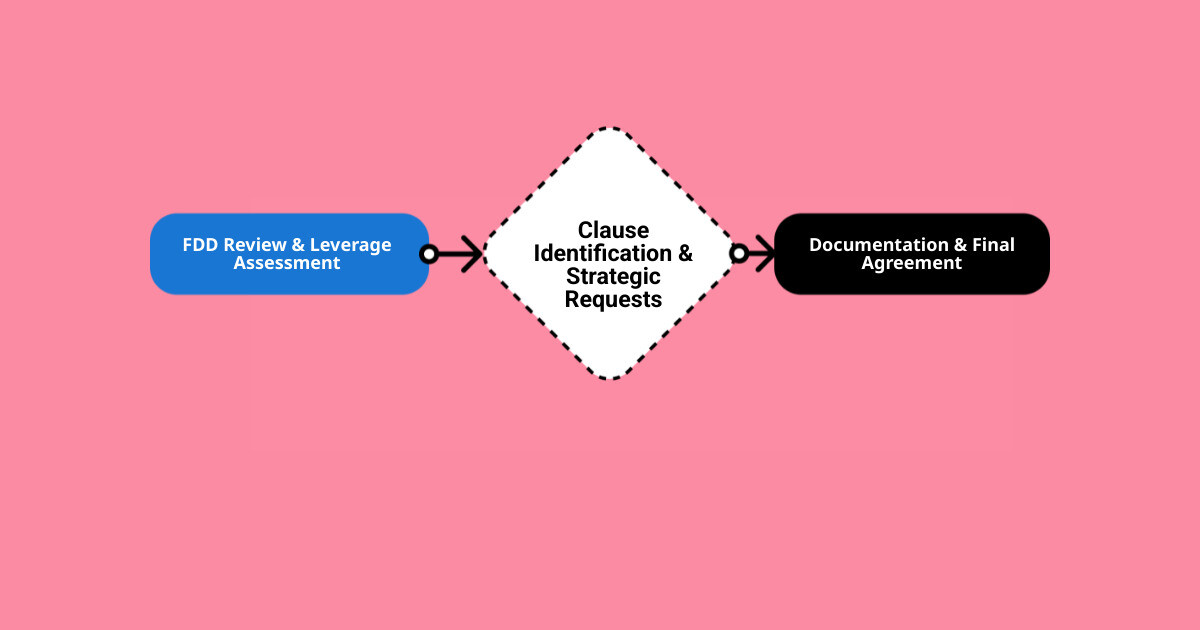
Understanding the Playing Field: Why Franchisors Are Cautious
Receiving a 50-page franchise agreement can be overwhelming, and it often feels one-sided. This isn’t arbitrary; franchisors have legitimate business reasons for their cautious approach to franchise agreement negotiation. Understanding their perspective is key to negotiating effectively.
The core reason is brand consistency. Customers expect the same quality and experience at every location, which is the foundation of a successful franchise. Standardized agreements ensure this system uniformity, protecting the brand’s reputation and the value of every franchisee’s investment—including yours. Imagine if every location had different standards; the brand’s value would quickly erode.
Legally, franchisors must also maintain consistency. Franchise law and the Franchise Disclosure Document (FDD) require them to treat franchisees similarly. Negotiating vastly different terms with each franchisee could lead to regulatory issues. This doesn’t eliminate negotiation, but it does mean changes must be made thoughtfully.
The agreement is designed to protect brand value and intellectual property. The franchisor has invested heavily in building its reputation and systems. The contract’s protective stance ensures operational efficiency and safeguards the very asset you are buying into.
For a deeper look at what makes franchise agreements negotiable (and what doesn’t), this resource offers helpful context: Are Franchise Agreements Negotiable?

The Power of Standardization
Franchise agreements are often called adhesion contracts, meaning they are standardized with limited room for negotiation. This isn’t to take advantage of franchisees, but to create an efficient, scalable system. Custom-negotiating every contract would be unmanageable and create inequality within the network.
Standardization puts all franchisees on equal footing, which protects you from a scenario where others have “sweetheart deals.” This fairness is crucial for a healthy franchise community.
This is particularly true for protecting intellectual property. Trademark provisions—governing the use of the brand’s name and logo—are almost always non-negotiable. These assets provide instant recognition and value; diluting them would harm every franchisee. The same applies to core brand standards for products and services, which are essential for maintaining quality and consistency.
The Franchisor’s Incentive for Flexibility
While core standards are vital, smart franchisors know that flexibility can be a strategic advantage. Their success depends on attracting strong candidates with the financial strength and business acumen to succeed. Offering some concessions can be necessary to secure these high-caliber partners.
For instance, a franchisor is more likely to be flexible with a multi-unit developer who brings significant growth to the system. They may also need to adapt to local markets, as a one-size-fits-all approach can deter strong franchisees who understand their unique area.
There are clear benefits for the franchisor in being flexible for candidates with unique value, such as an existing business to convert or valuable industry expertise. In these cases, flexibility is smart business.
Understanding the franchisor’s motivations—protecting the brand while ensuring growth—helps you frame requests in a way that makes business sense to them. This is how you can turn a potential “no” into a productive conversation.
Identifying Your Leverage: Factors That Strengthen Your Position
Not all franchisees have the same negotiating power. Understanding your leverage—what makes you a valuable partner—is critical for a successful franchise agreement negotiation. Franchisors want strong franchisees who will grow their brand, so the more you offer, the more flexible they may be.
I tell my clients, “You’re not just asking for favors—you’re making a business case for why flexibility makes sense for both parties.”
Your leverage depends on several factors: the franchise system’s maturity, your professional background, your financial strength, and your commitment to multiple units. Converting an existing business also provides leverage, as you bring an established customer base.
Knowing where you stand allows for a strategic approach. Our franchise buying services help you identify and use these leverage points effectively.
New and Emerging vs. Mature Franchise Systems
The age and size of the franchise system significantly impact your negotiating power.
Start-up and emerging franchises are generally more open to negotiation. They are hungry for growth and must attract quality franchisees to build momentum. As a result, they often offer concessions on initial fees, territory arrangements, or opening timelines.
Mature, established franchise systems with hundreds or thousands of locations are less flexible. They often have a waiting list of candidates and a proven model built on consistency. Negotiation is still possible but is typically limited to specific items that don’t affect core brand standards. The larger the system, the more rigid the terms usually are.
The Power of a Multi-Unit Deal
Committing to a multi-unit deal significantly strengthens your negotiating position. Franchisors favor multi-unit operators because they represent efficient, accelerated growth.
This leverage can lead to tangible concessions. Initial fees often become more negotiable, with potential reductions or tiered pricing for subsequent units. You might also arrange staggered payment terms.
Development schedules can also be more flexible, as franchisors understand the complexities of opening multiple locations. Most importantly, you can often negotiate for future development rights or a right of first refusal for adjacent territories, protecting your future growth.
Your financial strength is crucial. Demonstrating the capital and experience to execute a multi-unit plan proves you are a serious partner, giving you real power when discussing terms.
The Art of the Possible: Your Guide to Franchise Agreement Negotiation
With an understanding of the franchisor’s perspective and your leverage, it’s time for strategy. Franchise agreement negotiation is about making a well-reasoned business case for specific changes that protect your investment without harming the system.
You likely have more room to negotiate than you think. As one franchise attorney noted, “Unless you’re requesting something truly outrageous, you have more leeway to negotiate your terms than you think.” The key is to focus your energy and frame requests properly.

Successful negotiations focus on terms that benefit the franchisee without disrupting system-wide consistency. Approach conversations with a win-win attitude; you are potential partners. Frame requests around how they will help you succeed within their system. For more insights, read Yes, You Can Negotiate with Franchisors. Here’s How.
To help you understand what’s realistic, here’s a breakdown of what’s on and off the table:
| Typically Negotiable Clauses | Generally Non-Negotiable Clauses |
|---|---|
| Initial Franchise Fee (reductions for multi-unit, payment terms) | Continuing Royalty Fee Rate |
| Territory Geography (size, definition, right of first refusal) | Core Trademark Provisions |
| Timing of Opening for Business | System-Wide Operational Standards |
| Personal Guarantees (limits, exclusions) | Grounds for Termination by Franchisor |
| Renewal Rights (conditions, fees, term length) | Brand Development Fund Contributions |
| Cure Periods for Defaults | Product/Service Restrictions (if essential to brand) |
| Grand Opening Support & Marketing | Core Supply Chain Requirements |
| Transfer Fees (modifications) | Franchisor’s Right to Protect Brand Reputation |
Key Areas for a Successful Franchise Agreement Negotiation
Here are the areas where I’ve seen the most negotiation success, as they can be customized without compromising the system’s integrity.
Territory protection is often negotiable. You might secure a larger area, clarify boundaries, or negotiate a “right of first refusal” for adjacent territories. This is crucial in growing markets like Las Vegas, NV.
Renewal rights protect your future income. Negotiate for clear, predictable renewal terms, conditions, and fees to avoid surprises or costly reinvestment requirements when your initial term ends.
Personal guarantees, while usually required, can be refined. I’ve helped clients negotiate caps on liability, time limits on the guarantee, or exclusions for non-active shareholders.
Cure periods for defaults are vital. They give you time to fix minor violations before facing termination. Negotiating for longer or clearer cure periods can be a business-saver.
Grand opening support and timing is another flexible area. You may be able to negotiate for extended field support, additional training, or a contribution to your opening advertising. The timeline for opening is also often negotiable.
Clauses That Are Typically Off-Limits
It’s equally important to know which clauses are typically off-limits. Franchisors rarely budge on provisions fundamental to their business model.
Royalty fees, the franchisor’s primary revenue source for ongoing support, are almost never negotiable.
Brand development fund contributions are also fixed, as these pooled funds pay for system-wide marketing that benefits everyone.
Core trademark provisions are non-negotiable. The brand’s trademarks are its most valuable asset and must be protected uniformly.
System-wide operational standards are the “secret sauce” that ensures consistency and quality. Negotiating these would undermine the customer experience.
Termination grounds are rigid because franchisors need clear grounds to remove non-compliant franchisees to protect the brand and other operators.
Assembling Your Team and Finalizing the Deal
You shouldn’t tackle franchise agreement negotiation without the right team. This is one of the most significant contracts you’ll sign, and experienced professionals can prevent costly mistakes.

As a franchise consultant, I help clients with strategy and understanding the business implications of the agreement. However, you absolutely need a franchise-specific attorney for legal protection.
I help you see what’s possible, while your lawyer ensures it’s legally sound. Together, we form a powerful team to give you clarity and confidence.
The Crucial Role of Your Franchise Lawyer
A franchise lawyer protects your financial future. You need a specialist, not a general practice attorney.
A skilled franchise attorney performs a detailed contract review, cross-referencing the agreement with the Franchise Disclosure Document (FDD) to spot hidden issues. Their expertise is in identifying risks like aggressive personal guarantees, restrictive non-compete clauses, or unfair renewal terms.
They will then recommend realistic changes, knowing what franchisors are likely to accept. Your lawyer can also handle negotiating on your behalf with the franchisor’s legal team, keeping the process professional and efficient. Finally, they are crucial for ensuring legal compliance with all relevant federal and state franchise laws.
How to Ensure Negotiated Changes Are Legally Binding
A critical mistake is relying on verbal agreements. In franchise law, if it’s not in writing, it doesn’t exist.
Negotiated changes are documented through riders or addenda, which are legally binding attachments to the main agreement. Franchisors rarely rewrite the core contract.
Your addendum must be crystal clear, specifically referencing the sections being modified. Vague language is unenforceable. Your franchise lawyer should conduct a final review of the agreement and all addenda to ensure accuracy and consistency before you sign.
The signatures and execution step is final. Both parties must sign and date all addenda. Keep fully executed copies for your records. I tell every client: if it’s not in writing and signed, it never happened.
Navigating Risks and Knowing When to Walk Away
Knowing when to push and when to walk away is as important as knowing what to negotiate. Franchise agreement negotiation requires advocating for yourself without damaging the long-term partnership.
Pushing too hard on every term can make a franchisor see you as a source of future conflict. They are evaluating you, too. Conversely, don’t ignore red flags because you’ve fallen in love with the brand. These issues rarely resolve themselves.
What are the red flags in a negotiation?
My experience as a franchisor and consultant has taught me to spot these warning signs:
A franchisor who’s too willing to negotiate on core terms like royalties or operational standards could signal desperation or a weak concept. Healthy systems don’t need to compromise their fundamental structure.
Lack of transparency, such as evasive answers to direct questions, is a problem. A reputable franchisor should explain every provision clearly.
Pressure tactics are another red flag. Be wary of any franchisor who discourages hiring a lawyer or rushes you to sign. A good partner wants you to be informed. For more on what proper due diligence looks like, check out this resource on performing proper due diligence.
Inconsistent answers, where what you’re told contradicts the written agreement, suggest disorganization or deception.
When should you walk away from a franchise deal?
Sometimes the smartest move is to walk away, even after investing time and energy. Here’s when to consider it:
A core values mismatch is a major issue. If the franchisor’s ethics or business practices don’t align with yours, these differences will likely cause constant friction.
Unacceptable financial risk is a clear deal-breaker. If the numbers don’t add up to a reasonable return, or if the capital required jeopardizes your financial security, it’s okay to say no.
Non-negotiable deal-breakers are terms you cannot accept. If the franchisor won’t budge on an unfair personal guarantee or restrictive territory, signing anyway will lead to resentment.
Poor validation with existing franchisees is a critical warning sign. If current franchisees are unhappy or warn you about the franchisor, listen to them. Their experience is the best predictor of your own.
A franchise is a long-term partnership. Entering it with fundamental disagreements is a recipe for failure. Walking away can be the bravest and smartest decision.
Frequently Asked Questions about Franchise Agreement Negotiation
How much can you negotiate on a franchise fee?
The initial franchise fee is more negotiable than ongoing royalties because it’s a one-time payment. Your leverage increases if you’re a strong candidate or committing to a multi-unit deal, where franchisors may reduce the fee per unit or offer staggered payment terms. However, outright reductions are often limited, as the fee covers real costs like training and initial support. Negotiating payment terms, such as deferring a portion of the fee, can be a successful strategy.
What is a “right of first refusal” and is it negotiable?
A “right of first refusal” (ROFR) gives you the first option to buy an available adjacent territory before the franchisor offers it to anyone else. It’s a valuable tool for securing future growth.
Yes, an ROFR is highly negotiable, especially for multi-unit developers. You can negotiate the scope (which territories it covers), the terms (e.g., price matching), and the timeframe to exercise the right. If you are serious about growth, this is a clause worth pursuing, but ensure the terms are clearly defined in your agreement.
Can I negotiate the non-compete clause?
Yes, non-compete clauses are often negotiable. While standard for protecting the franchisor, they must be “reasonable” to be enforceable. An overly broad clause may not hold up in court.
You can often negotiate:
- The geographic scope: Reduce the restricted radius around your location.
- The time limitation: Shorten the post-term restriction period (e.g., from five years to two).
- The scope of business: Clarify that the restriction only applies to directly competing businesses, not all similar ventures.
A franchise lawyer is essential for negotiating a non-compete that protects the franchisor without unfairly restricting your ability to earn a living if the franchise relationship ends.
Conclusion: Securing a Fair and Profitable Partnership
Franchise agreement negotiation isn’t about “winning”; it’s about creating a fair, respectful, and profitable partnership. The negotiation process is a preview of your long-term relationship with the franchisor.
Successful franchisees are prepared. They understand their leverage, focus on key clauses like territory and renewal rights, and make a solid business case for their requests. They also assemble the right team, including a skilled franchise attorney for legal protection and a consultant for strategic guidance.
Thoughtful negotiation builds a strong foundation for your future, but knowing when to walk away is just as crucial. If a franchisor won’t budge on your deal-breakers or if the process reveals red flags, trust your instincts. Forcing a bad fit is a costly mistake.
At Main Entrance Franchise Consulting, my experience as a Certified Franchise Executive and a franchisor gives me a unique insight into how to negotiate effectively. I know where franchisors have flexibility and how to frame requests for success.
We offer expert guidance with flexible compensation models and no upfront costs, helping you steer the franchise agreement negotiation process without adding to your initial burden. Whether it’s your first franchise or a multi-unit deal, we can help you secure terms that set you up for long-term success.
If you’re ready to start your franchise journey with confidence, let’s find the right fit and negotiate the best possible terms. Start your franchise buying journey with expert guidance.