

Your Pathway to the U.S.: Understanding the E-2 Visa and Franchising
How to get an e-2 visa through a franchise is a question asked by thousands of foreign entrepreneurs each year who dream of building a business and life in the United States. Here’s the quick answer:
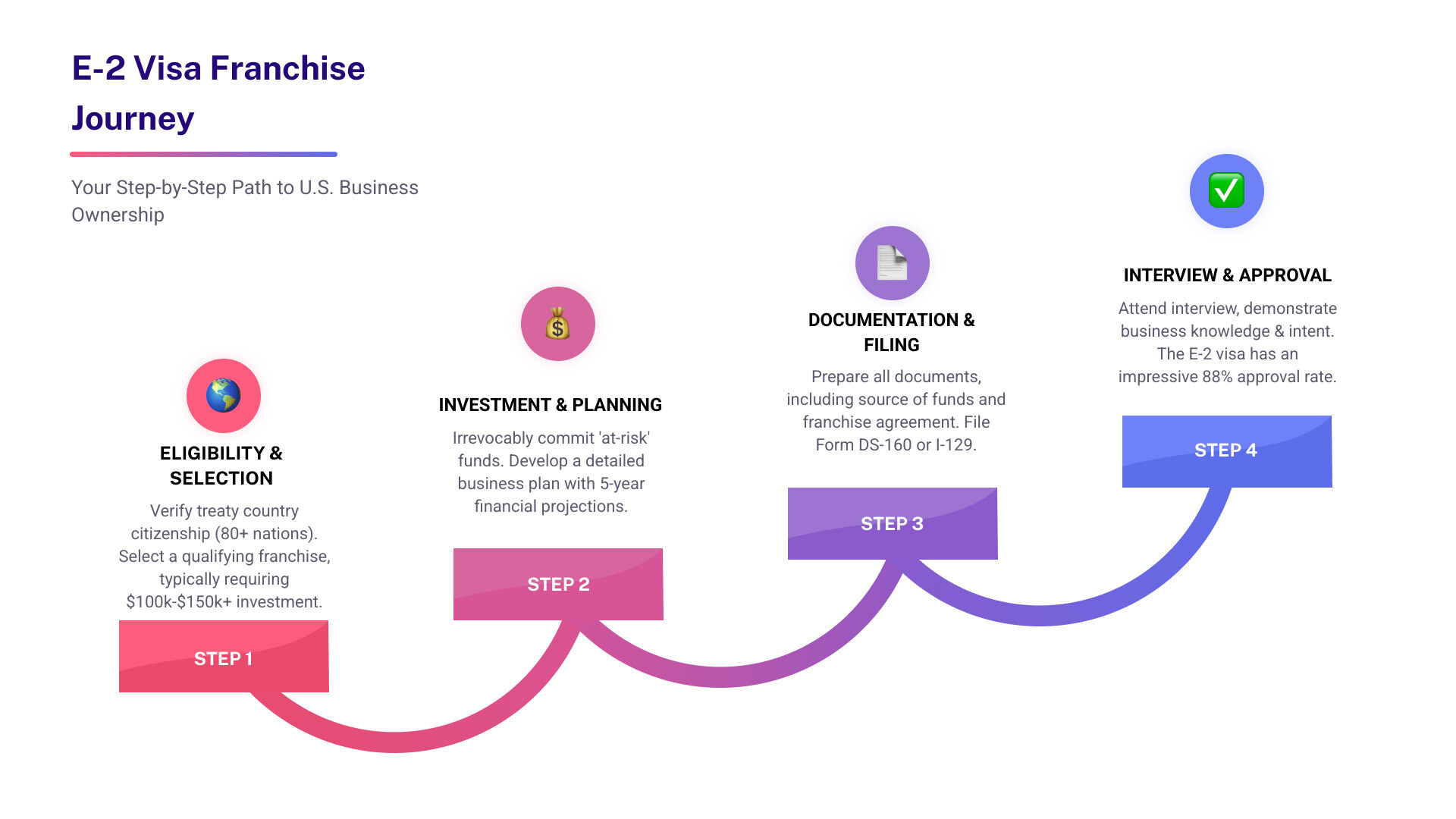
How to Get an E-2 Visa Through a Franchise:
- Verify treaty country citizenship – You must be a national of one of the 80+ countries with an E-2 treaty with the U.S.
- Select a qualifying franchise – Choose a franchise that requires substantial investment (typically $100,000-$150,000+) and allows active management
- Commit funds irrevocably – Invest capital that is “at risk” in the franchise business
- Prepare comprehensive documentation – Create a detailed business plan, prove lawful source of funds, and sign the franchise agreement
- File Form DS-160 – Apply at a U.S. consulate in your home country (or file Form I-129 for change of status if already in the U.S.)
- Attend visa interview – Demonstrate your intent to develop and direct the business
The E-2 Treaty Investor visa is a non-immigrant visa that allows you to enter the United States to invest in and actively operate a business. Unlike the EB-5 visa, which requires a minimum investment of $800,000 and leads to permanent residency, the E-2 visa has no official minimum investment amount and focuses on “substantial” capital relative to the business cost.
Franchising has become one of the most popular vehicles for E-2 visa applicants. Why? Franchises offer proven business models, established brand recognition, and comprehensive training and support systems. These factors translate into a lower-risk investment that immigration officers view favorably. In fact, an estimated 70% of American franchises meet E-2 visa eligibility criteria—that’s about 1,400 franchise options—and the E-2 visa boasts an impressive 88% approval rate.
When you invest in a franchise, you’re buying into a turnkey business opportunity with known costs, documented financial performance, and operational procedures already in place. This makes it much easier to demonstrate that your investment is substantial, your business is bona fide (real and operational), and you have a clear plan to develop and direct the enterprise—all critical requirements for E-2 visa approval.
I’m Max Emma, a Certified Franchise Executive and consultant who has helped countless entrepreneurs steer the intersection of franchise ownership and immigration pathways, including understanding how to get an e-2 visa through a franchise. My experience as both a franchisor and franchisee gives me unique insight into which franchise models align best with visa requirements and how to structure your investment for success.
Are You Eligible? Key Requirements for an E-2 Visa Franchise
Starting on the journey of how to get an e-2 visa through a franchise begins with understanding the fundamental eligibility requirements. These criteria are designed to ensure that you, as an investor, are genuinely committed to developing and directing a legitimate U.S. business that contributes to the American economy.

Meeting the Core E-2 Visa Criteria
The E-2 visa is unique because it’s tied to treaties of commerce and navigation between the United States and specific countries. This means not everyone is eligible based on nationality alone.
-
Treaty Country National: The first and most crucial step is to confirm that you are a citizen of a country that holds a treaty with the United States. Without this, an E-2 visa is simply not an option. Major eligible countries include the United Kingdom, Germany, Japan, South Korea, and many others. You can Check the current treaty country list on the State Department website to verify your eligibility.
-
Active Investment: The E-2 visa is not for passive investors. You must make a substantial investment in a U.S. enterprise that is “at risk.” This means the funds must be genuinely committed to the business and subject to potential loss if the business fails. The investment must be irrevocably committed before your visa interview, typically by spending funds on business assets or placing them in an escrow account contingent only on visa approval.
-
Develop and Direct: Your role in the business must be to actively develop and direct the enterprise. This means you won’t just be a shareholder; you’ll be actively involved in the day-to-day operations and strategic decision-making. This is typically evidenced by having at least 50% ownership or having operational control over the enterprise, such as serving as a manager or executive. The U.S. government wants to see that you are an entrepreneur driving the business forward, not merely a recipient of profits.
-
At Least 50% Ownership or Operational Control: While 50% ownership is a common benchmark, the key is demonstrating control. If you own less than 50%, you must clearly show that you have operational control through your managerial position or other agreements that grant you significant decision-making authority.
Understanding the Financials: How to Get an E-2 Visa Through a Franchise
One of the most frequently asked questions about the E-2 visa is regarding the investment amount. It’s a bit nuanced, so let’s break it down.
-
Substantial Investment: The U.S. government does not provide a specific dollar threshold for an E-2 visa. Instead, it requires a “substantial investment.” This term is interpreted relative to the total cost of the business and must be sufficient to ensure its successful operation. The investment must be proportional to the total cost of the business, typically requiring 50% or more of the total business cost. For lower-cost businesses (e.g., under $100,000), the investment should typically be close to 100% of the total cost. For higher-cost businesses (e.g., over $500,000), a lower percentage investment may be acceptable, but it must still be sufficient to ensure the business’s viability.
-
No Official Minimum, But Recommendations Exist: While there’s no legally mandated minimum, experience shows that most successful E-2 visa franchise applications involve investments of at least $100,000 to $150,000. Generally speaking, the investment shouldn’t be less than $120,000. Many successful applicants invest $200,000 to $500,000 to ensure they meet substantial investment requirements while also providing adequate working capital. Low-cost E-2 visa franchise opportunities, particularly home-based and mobile service franchises, can offer entry points in the $50,000 to $150,000 range. For example, service-based or consulting businesses may require investments as low as $60,000–$100,000. If you are investing in a physical location, such as a restaurant or retail store, investments often range from $150,000–$300,000.
-
Proportionality Test: This is how consular officers assess the “substantial” nature of your investment. It’s not just about the dollar amount, but how that amount compares to the total value of the business. A smaller business might require a higher percentage of the total cost to be invested by you, while a larger, more expensive business might allow for a lower percentage, as long as it’s still a significant amount.
-
At-Risk Funds: As mentioned, your investment must be genuinely committed to the business and subject to potential loss. This means the funds cannot be secured by the assets of the business itself. Funds in an escrow account can qualify if the release of funds is solely contingent on visa approval.
-
Lawful Source of Funds: You must clearly document the legal source of your investment funds. This requires providing a detailed paper trail of how you acquired the money, whether through savings, sale of property, inheritance, or other legitimate means. This is a critical step to prevent money laundering and ensure compliance.
-
Working Capital: Beyond the initial purchase and setup costs, your investment should also include sufficient working capital to operate the business until it becomes profitable. This demonstrates foresight and commitment to the business’s long-term success.
The Business Must Be “Bona Fide”
The E-2 visa is intended for real, active commercial enterprises, not speculative investments or passive ventures.
-
Real and Operational: The business you invest in must be a bona fide, active, and operating commercial undertaking that produces services or goods for profit. It cannot be an undeveloped plot of land, stocks, or a business that exists only on paper. Franchises are often viewed favorably here because they typically come with established operations.
-
Not Marginal: The business must not be “marginal.” This means it must have the present or future capacity to generate more than a minimal living for you and your family. If it’s a new enterprise, you’ll need to demonstrate, via a robust business plan, that it has the potential to become profitable and contribute significantly to the U.S. economy within five years.
-
Generates More Than a Minimal Living: This ties directly to the “not marginal” requirement. The business should show the potential to create sufficient income for your livelihood, beyond just covering basic expenses.
-
Creates U.S. Jobs: While there’s no set minimum for the number of jobs created (unlike the EB-5 visa), the business should demonstrate that it contributes to the U.S. economy by employing U.S. workers. This is a positive factor that strengthens your application.
-
Economic Contribution: The overarching goal is to show that your business is a positive force in the U.S. economy, providing goods or services, creating jobs, and generating tax revenue.
Step-by-Step: How to Get an E-2 Visa Through a Franchise
Navigating the E-2 visa application process, especially when investing in a franchise, can seem daunting. However, by breaking it down into manageable steps, we can explain the journey and guide you toward success.

Step 1: Research and Select a Suitable Franchise
This is perhaps the most critical initial phase, directly impacting your E-2 visa eligibility and your business success. Our role at Main Entrance Franchise Consulting is to provide unbiased, personalized guidance at no cost to you, connecting you with suitable opportunities.
-
Identify Suitable Franchise Industries: Not all franchises are created equal when it comes to E-2 visa suitability. We look for franchises that align with E-2 requirements for active management and substantial investment. Popular and often suitable industries include:
- Service-based Franchises: These often have lower initial investments ($75,000-$250,000) and require active owner involvement, making them excellent candidates. Examples include cleaning services, tutoring centers, and home repair.
- Food and Beverage Franchises: While often requiring higher investments ($200,000-$500,000), their clear operational models and job creation potential make them viable.
- Business Services Franchises: These cater to other businesses and often have predictable revenue streams, with investments typically ranging from $100,000 to $300,000.
- Real Estate and Property Management Franchises: The U.S. short-term rental market is booming, projected to exceed $103 billion by 2033. Property management franchises, with investments typically from $80,000 to $170,000, offer accessible entry points and high demand.
- We can help you steer these options.
-
Find E-2 Friendly Franchisors: Some franchisors have experience working with E-2 visa applicants and understand the specific documentation and timing requirements. They might even have preferred immigration attorneys they can recommend. We have a national network of hundreds of proven franchise brands, and we can help you identify those with a track record of success with E-2 investors.
-
Due Diligence is Key: Once you have potential franchises in mind, thorough due diligence is paramount. This involves:
- Reviewing the Franchise Disclosure Document (FDD): This legal document provides comprehensive information about the franchisor, the business model, fees, investment requirements, and financial performance. It’s essential reading.
- Speaking with Existing Franchisees: This is invaluable. You’ll gain real-world insights into the business’s operations, franchisor support, and profitability.
- Attending Findy Days: Meeting the franchisor’s team helps you assess the company culture and support system.
-
Our Franchise Buying Process: We provide an education-first approach, in-depth franchise matching, and a streamlined findy process that helps clients confidently choose a franchise aligned with their goals, budget, and lifestyle. For a deeper dive into how we assist you in this crucial stage, you can find More info about our Franchise Buying process.
Step 2: Commit Funds and Prepare Documentation
With a suitable franchise selected, the next step involves making the financial commitment and carefully preparing your application documents.
-
Irrevocably Committed Funds: As discussed earlier, your investment must be “at risk” and irrevocably committed. This means the funds are either spent on business assets (e.g., equipment, inventory, leasehold improvements) or placed into an escrow account, with the release of funds contingent only on your E-2 visa approval. This step must be completed before you file your E-2 visa application.
-
Business Plan Creation: A detailed, comprehensive business plan is the backbone of your E-2 visa application. It must clearly demonstrate:
- The nature of your business and its market.
- Your management structure and your role.
- Your operational strategies.
- Realistic 5-year financial projections showing the business’s capacity to generate more than a marginal living for you and contribute to the U.S. economy.
- How the business will create jobs for U.S. workers.
- Many applicants hire professional business plan writers to ensure this document meets USCIS standards.
-
Source of Funds Documentation: This is where you provide the clear paper trail proving the lawful origin of your investment funds. This could include bank statements, tax returns, property sale documents, inheritance records, and any other financial records that trace the money from its source to its investment in the U.S. business.
-
Franchise Agreement: The signed franchise agreement will be a key document, demonstrating your commitment to the franchise and outlining the terms of your business relationship. Ensure it includes any necessary contingencies related to visa approval.
Step 3: File the Application and Prepare for the Interview
This is the formal submission and adjudication phase of your E-2 visa journey.
-
Form DS-160: The primary nonimmigrant visa application form, Form DS-160, is completed online. This form gathers your personal information, travel history, and details about your proposed business. The processing fee for Form DS-160 is $315 (as of 2025).
-
Consular Processing vs. Change of Status:
- Consular Processing: If you are outside the U.S., you will apply at a U.S. consulate or embassy in your home country. This typically involves submitting your application package, paying fees, and attending an interview. Consular processing times are generally 2–12 weeks.
- Change of Status: If you are already in the U.S. on a different nonimmigrant visa (e.g., B-1/B-2), you may be able to apply for a change of status to E-2 with USCIS using Form I-129 (Petition for Nonimmigrant Worker), which costs $510–$1,015. This process usually takes 2–4 months, but premium processing for an additional $2,805 can expedite it to 15 business days. That a change of status within the U.S. does not grant you a visa stamp in your passport, so if you travel internationally, you would need to apply for an E-2 visa stamp at a consulate to re-enter.
-
Common Interview Questions: Be prepared for your interview, as consular officers will want to confirm your intent and understanding of the business. Common questions include:
- What is your business, and what services/products does it offer?
- What is your experience relevant to this business?
- How much have you invested, and where did the funds come from?
- What is your role in the business?
- How many U.S. employees will you hire?
- What are your projected revenues and expenses?
- What is your plan for the business if the visa is denied?
- Crucially, you must demonstrate your intent to depart the U.S. upon the termination of your E-2 status, as it is a nonimmigrant visa.
-
Demonstrating Business Knowledge: Show a clear understanding of your chosen franchise’s operations, market, and challenges. Your ability to articulate your business plan and commitment will be vital.
-
Reciprocity Fees and Documentation: Depending on your country of citizenship, a reciprocity fee may apply. These are additional charges imposed on applicants from countries that charge U.S. citizens similar fees for visas. You can Check for additional fees or documentation requirements by country using the U.S. Department of State Reciprocity Tables. Always consult the USCIS Fee Schedule and the U.S. Department of State’s visa fee pages for the latest information.
Navigating the Journey: Benefits, Challenges, and Visa Comparisons
Choosing how to get an e-2 visa through a franchise is a strategic decision that comes with distinct advantages and potential problems. Understanding these, along with how the E-2 visa compares to other investor visas, is crucial for making an informed choice.
Why Choose a Franchise for Your E-2 Visa?
Franchising is not just a business model; it’s a proven pathway for E-2 visa applicants, offering several compelling benefits:
-
Proven Business Model: One of the biggest advantages is that you’re investing in a concept that has already been tested and refined. This significantly reduces the risk associated with starting a new, independent business from scratch. Franchises inherently meet the active management requirement for E-2 visas because they necessitate hands-on involvement.
-
Brand Recognition: Many franchises come with established brand names that consumers already trust. This gives you a significant head start in attracting customers compared to building a new brand from the ground up.
-
Franchisor Support and Training: Franchisors provide extensive training, operational manuals, marketing strategies, and ongoing support. This is invaluable for new business owners, especially those unfamiliar with the U.S. market or a particular industry. This structured support system also strengthens your E-2 application by demonstrating a higher likelihood of business success.
-
Easier to Prove “Substantial” Investment: Franchises often have clearly defined investment costs, including franchise fees, equipment, build-out, and initial inventory. These known, documented expenses make it easier to demonstrate that your investment is “substantial” and genuinely committed to the business, which is a key requirement for the E-2 visa.
-
Streamlined Business Plan: A franchisor typically provides a template or guidance for creating a business plan that aligns with their model. This makes the process of developing the comprehensive 5-year business plan required for the E-2 visa much more manageable and credible. Easier Visa Approval – Investing in a franchise can simplify the E‑2 visa process because it’s a proven, operational business with documented financials and support systems.
E-2 Visa vs. EB-5 Visa: What’s the Difference?
While both the E-2 and EB-5 are investor visas, they serve very different purposes and have vastly different requirements. Understanding these distinctions is critical when planning your move to the U.S.
| Feature | E-2 Visa (Treaty Investor) |