

Why Franchise Buying Offers a Smarter Path to Business Ownership
Franchise buying is the process of purchasing the right to operate a business under an established brand’s name, systems, and support structure. Instead of starting from scratch, you gain instant access to a proven business model, recognized brand, training programs, and ongoing operational guidance—all in exchange for an initial franchise fee and ongoing royalty payments.
Here’s what franchise buying involves:
- Initial Investment: Franchise fees average $35,185, plus start-up costs for real estate, equipment, and inventory
- Ongoing Fees: Royalty payments (typically 4-7% of gross sales) and marketing contributions
- Support System: Training, site selection, marketing, and operational guidance from the franchisor
- Legal Framework: Review of the Franchise Disclosure Document (FDD) and franchise agreement
- Due Diligence: Speaking with current franchisees, evaluating financial performance, and assessing personal fit
Franchises have an 8% higher success rate than independent businesses because you’re going into business for yourself, but not by yourself. You follow a tested system while benefiting from the franchisor’s brand power, bulk purchasing, and marketing muscle.
I’m Max Emma, a Certified Franchise Executive (CFE) and founder of Main Entrance Franchise Consulting, where I help individuals steer the franchise buying process after decades of experience as both a franchisor and franchisee across multiple brands. My mission is to guide you toward a franchise that aligns with your goals, budget, and lifestyle—without the guesswork.
What is a Franchise? Understanding the Business Model
At its core, a franchise represents a powerful business model where one business owner, known as the “franchisor,” grants the rights to their established business logo, name, and operational model to an independent entrepreneur, the “franchisee.” This relationship is symbiotic: the franchisor expands their brand footprint and revenue, while the franchisee gains a head start with a recognized brand and a proven system. This structure is why franchise buying is often seen as a less risky entry into entrepreneurship.

Defining Franchising and How It Differs from a Business Opportunity
While often confused, a franchise is distinctly different from a general business opportunity. When you engage in franchise buying, you enter into an ongoing relationship with the franchisor. This means you adhere to their rules and agreements, benefit from their established brand system, and receive continuous support. In return, you typically pay initial franchise fees and ongoing royalty payments based on your sales. This structure provides a significant level of support and a blueprint for success, but also entails less independence.
A business opportunity, on the other hand, usually involves selling products or services created by another company, but without the strict rules, ongoing support, or long-term relationship characteristic of a franchise. You might purchase equipment or inventory from a supplier, but you operate with much more autonomy. Business opportunities generally have a lower upfront cost and often no ongoing royalty fees, but they also lack the comprehensive support system and brand recognition that come with franchise buying. For a step-by-step overview of the benefits and responsibilities of buying a franchise, we recommend reviewing A Consumer Guide to Buying a Franchise from the Federal Trade Commission.
The Two Main Types of Franchising
Franchising primarily comes in two forms, each offering a different level of engagement and support:
- Business Format Franchising: This is the most common and comprehensive type of franchising. Here, the franchisor not only grants the right to use their trademark but also provides a complete system for conducting business. This includes everything from site selection, detailed operational manuals, initial and ongoing training, marketing strategies, and even advice on management. Restaurants, hotels, and many service-oriented businesses are prime examples of business format franchises, offering a full-spectrum business management relationship. When you hear about franchise buying, this is usually what people are referring to.
- Product/Trade Name Franchising: This model is simpler, focusing primarily on the supply chain. The franchisor owns the name or trademark and licenses it to franchisees who sell the franchisor’s products. Think of car dealerships or gasoline stations, where the emphasis is on distributing a specific product line under a recognized brand. While brand recognition is present, the ongoing support and operational guidance are generally less extensive than in business format franchising.
Common Franchise Ownership Models
When exploring franchise buying, you’ll encounter several ownership models, each with different implications for your involvement and growth potential:
- Single-Unit Franchise: This is the most straightforward model, where you purchase the right to operate one specific franchise location. You are typically responsible for the day-to-day operations of that single unit. It’s a great starting point for many first-time franchisees.
- Multi-Unit Franchise: As the name suggests, this involves purchasing the rights to open and operate multiple franchise units within a specified territory. This model is for entrepreneurs looking to scale their business and build a larger enterprise over time, often following a pre-agreed development schedule.
- Area Developer: An area developer commits to opening a certain number of units within a larger, exclusive territory over a specific timeframe. They don’t typically sell franchises to others but are responsible for the development and operation of all units within their designated area. This model requires significant capital and business development skills.
- Master Franchise: This is the highest level of franchise ownership. A master franchisee not only has the right to open multiple units but also gains the exclusive right to sell franchises to other entrepreneurs (sub-franchisees) within a large, defined territory. They then provide support and training to these sub-franchisees, earning a share of their initial fees and ongoing royalty streams. This model is akin to becoming a mini-franchisor yourself and demands extensive business and leadership experience.
The Pros and Cons of Franchise Ownership
Deciding whether franchise buying is the right path for you involves carefully weighing the advantages and disadvantages. While the allure of a proven system is strong, it’s crucial to understand the trade-offs.
| Pros (Advantages) | Cons (Disadvantages) |
|---|---|
| Proven Business Model | High Initial and Ongoing Costs |
| Established Brand Recognition | Strict Rules and Procedures |
| Comprehensive Training & Support | Limited Creative Freedom |
| Higher Success Rate (8% more likely) | Contractual Obligations and Terms |
| Easier Access to Financing | Potential for “Heavy-Handed” Support |
| Collective Purchasing Power | Less Independence and Autonomy |
The Advantages: A Proven System and Brand Power
One of the primary motivators for owning a franchise is the ability to go into business for yourself, but not by yourself. This means leveraging a proven business model and an established brand with a built-in customer base. Here’s why many entrepreneurs choose franchise buying:
- Proven Business Model: You don’t have to reinvent the wheel. Franchises offer a tested and refined operational blueprint that has already demonstrated success. This significantly reduces the risk associated with starting a new venture from scratch.
- Higher Success Rate: Statistics show that franchises have an 8% higher success rate than independent businesses. This is largely due to the established systems and ongoing support provided by the franchisor.
- Brand Recognition: You immediately benefit from an existing brand name, logo, and reputation. This translates to instant customer trust and reduced marketing efforts compared to building a brand from the ground up.
- Marketing Support: Franchisors typically provide national and regional marketing campaigns, advertising materials, and sometimes local marketing guidance, amplifying your reach.
- Comprehensive Training Programs: Franchisors offer initial training on everything from operations and sales to marketing and management, ensuring you’re well-equipped to run the business. Ongoing training keeps you updated on best practices.
- Site Selection Assistance: Many franchisors help with identifying and securing prime business locations, leveraging their experience and market research.
- Group Purchasing Power: As part of a larger network, franchisees often benefit from collective purchasing power, securing better prices on supplies, equipment, and inventory, which can significantly lower operational costs.
- Franchisee Network: You become part of a community of fellow franchisees who face similar challenges and successes, providing a valuable support and knowledge-sharing network.
At Main Entrance Franchise Consulting, we believe in empowering you with all the information you need to make an informed decision. Find More info about our franchise buying services and how we can help you steer these advantages.
The Disadvantages: Costs, Rules, and Less Independence
While the benefits are compelling, it’s equally important to understand the drawbacks of franchise buying:
- Lack of Independence: This is often cited as the biggest trade-off. As a franchisee, you must adhere to the franchisor’s strict rules, guidelines, and operational procedures. This can limit your creativity, innovation, and ability to set your own pricing or introduce new products/services. For entrepreneurs who desire significant creative freedom, this can feel “heavy-handed.”
- High Costs: As we’ll discuss, the financial commitment can be substantial, including initial franchise fees, significant start-up expenses, and ongoing royalty and marketing payments.
- Contractual Obligations: Franchise agreements are legally binding contracts that can run for as long as 20 years. They dictate nearly every aspect of your business, from approved suppliers to operating hours. Renewal is not guaranteed and may come with altered terms, potentially raising royalty payments or imposing new standards.
- Restricted Creativity: If you’re an entrepreneur with a strong vision for unique products or services, a franchise might feel confining. You typically can’t deviate from the established brand and offerings. An auto repair franchise owner, for example, might not be allowed to perform other types of automotive work not approved by the franchisor.
- Potential for Conflict: Disagreements can arise with the franchisor over operational changes, marketing strategies, or support levels. While most relationships are positive, understanding the potential for conflict is important.
For some entrepreneurs, the extensive support from the franchisor might feel overwhelming, leading to a frustrating lack of independence. It’s crucial to assess your personality and business goals: are you comfortable following a system, or do you thrive on complete autonomy?
Decoding the Financial Commitment of Franchise Buying
One of the most critical aspects of franchise buying is understanding the financial commitment involved. This includes not only the upfront costs but also the ongoing expenses necessary to operate your business successfully.

The Initial Investment: Franchise Fee and Start-Up Costs
The journey into franchise buying begins with a significant initial investment, comprising two main components:
- Franchise Fee: This is a one-time, upfront payment made to the franchisor for the right to use their brand name, trademark, and business system. This fee is typically non-refundable. The average franchise fee across all industries in the U.S. was $35,185. However, this can vary wildly based on the brand’s recognition and the industry. For example, a franchise like Subway might have a lower franchise fee around $15,000, while larger, full-service restaurant franchises could command fees upwards of $70,000.
- Start-Up Expenses: Beyond the franchise fee, you’ll incur substantial costs to get your business up and running. These can include:
- Real Estate: Leasehold improvements, purchase of property, or rent deposits.
- Equipment: Specialized machinery, furniture, fixtures, and technology.
- Initial Inventory: Stock to begin operations.
- Operating Licenses and Permits: Costs associated with legal compliance.
- Insurance: Business liability, property, and workers’ compensation insurance.
- Grand Opening Fee: Sometimes a separate fee for initial marketing and launch support.
- Working Capital: Funds needed to cover initial operating losses or expenses until the business becomes profitable.
These start-up and operating expenses can range dramatically. For a small home-based service franchise, the total initial investment might be under $50,000. For a larger brick-and-mortar restaurant or a lodging franchise, the total investment can easily run into six figures or even millions of dollars. It’s important to recognize that franchise buying offers opportunities across various investment levels, from under $10,000 to premium options exceeding $1,000,000.
Ongoing Expenses: Royalties and Marketing Fees
Once your franchise is operational, you’ll continue to pay fees to the franchisor to maintain your rights and receive ongoing support. These are primarily:
- Royalty Payments: These are recurring payments, typically a percentage of your gross sales, paid to the franchisor for the continued use of their brand, system, and ongoing support. Royalties vary significantly by industry. For instance, sit-down restaurants average around 4.47% of gross sales, while some automotive companies might see rates closer to 6.98%. The average royalty paid by franchisees across industries was about $35,000 a year.
- Marketing/Advertising Fees: Many franchisors require franchisees to contribute to a national or regional advertising fund. These fees, often 1-5% of gross sales, pool resources to create broader brand awareness and drive customer traffic. You might also have requirements for local marketing efforts. These funds support national marketing campaigns, operational support, and research and development, benefiting the entire franchise system.
Understanding these financial commitments is crucial for assessing the potential profitability and long-term viability of a franchise opportunity. We always advise potential franchisees to carefully review Item 7 of the Franchise Disclosure Document (FDD), which provides a detailed breakdown of these estimated initial investments and ongoing costs.
Your Step-by-Step Guide to the Due Diligence Process
Engaging in thorough due diligence is paramount when considering franchise buying. This means conducting exhaustive research and making an informed decision, rather than rushing into a commitment. It’s about empowering yourself with knowledge to choose wisely.
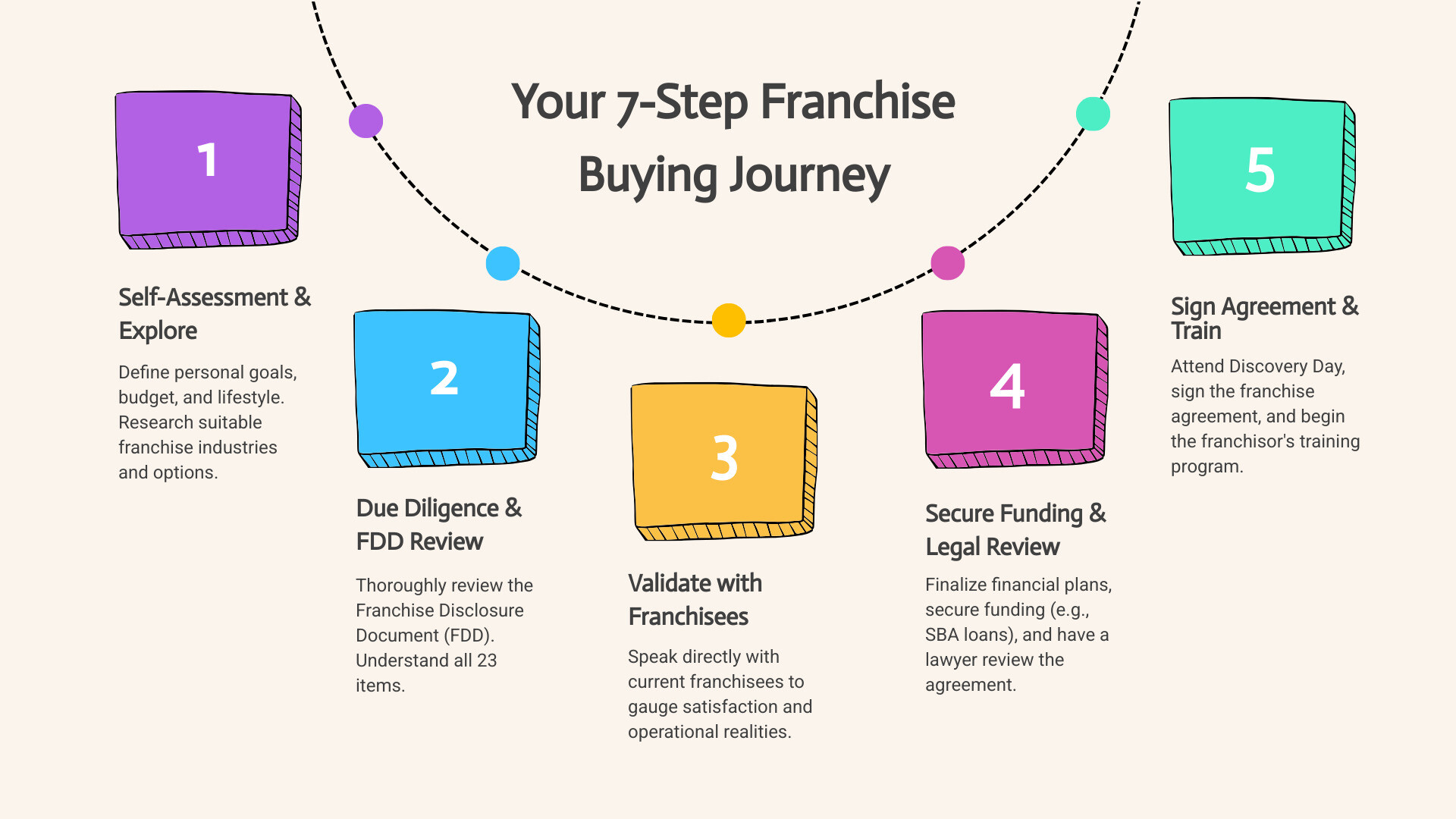
The First Step in Franchise Buying: Self-Assessment
Before diving into specific franchise opportunities, the most crucial first step is a deep self-assessment. This helps us ensure that any potential franchise aligns with your personal and professional aspirations. Consider:
- Personal Fit: Are you comfortable following a structured system, or do you crave complete autonomy? A franchise demands adherence to rules.
- Industry Choice: What industries genuinely excite you? What are your passions? While passion isn’t everything, it certainly helps with long-term commitment.
- Investment Level: What is your realistic budget for both initial investment and ongoing operational costs? How much capital do you have access to, and how much can you afford to lose?
- Personal Goals: What do you hope to achieve with franchise ownership? Is it primary income, supplemental income, wealth building, or a lifestyle change? How many hours are you willing to work?
- Work-Life Balance: Does the franchise model support the work-life balance you envision? Some franchises are owner-operated and demand long hours, while others can be semi-passive with a manager-run model.
- Skills Assessment: What are your strengths and weaknesses? Does the franchise require special training or experience that you possess, or that the franchisor will provide?
This introspective phase is where a franchise consultant truly shines. We help you define your goals, assess your capabilities, and narrow down the vast universe of options. To learn more about how our guidance can benefit you, visit What is a Franchise Consultant?.
Key Documents in Franchise Buying: The Franchise Disclosure Document (FDD)
The Franchise Disclosure Document (FDD) is the cornerstone of franchise buying due diligence. It’s a legal document mandated by the Federal Trade Commission (FTC) that franchisors must provide to prospective franchisees at least 14 days before any contract is signed or money is paid. The FDD contains 23 numbered “Items” that reveal critical information about the franchisor and the franchise system. We treat it as your ultimate research tool.
Here are some of the most important items to scrutinize:
- Item 19: Financial Performance Representations (FPR): If a franchisor makes any earnings claims (and they are not legally required to), they must be included here. Critically evaluate the source, limitations, and assumptions of this data. Are they gross sales or net profits? Do they reflect typical performance, or just top performers? Is the geographic relevance appropriate for your market? You should always seek written substantiation and consult with an accountant to verify these claims.
- Item 20: Franchisee and Outlet Data: This section provides a detailed history of franchised and company-owned outlets, including openings, closures, transfers, and terminations over the past three years. A high number of “Sold But Not Open” units, especially more than the number opened each year, can be a warning sign. This item helps you assess the franchise’s track record and franchisee turnover.
- Item 3: Litigation History: This item discloses any prior litigation involving the franchisor or its executives, including felony convictions, violations of franchise law, or lawsuits against franchisees. It can offer insights into potential disputes or operational challenges.
- Item 7: Estimated Initial Investment: As discussed, this provides a comprehensive, itemized list of all estimated start-up costs, giving you a clear picture of the total financial outlay required.
For a deeper dive into this vital document, refer to The FTC’s guide to the FDD.
Evaluating the Brand and Speaking with Franchisees
Beyond the FDD, a crucial part of your due diligence involves evaluating the brand itself and, most importantly, speaking with current and former franchisees.
- Franchisee Satisfaction: This is a powerful indicator of a franchise system’s health. The Franchisee Satisfaction Index (FSI), an industry standard established by Franchise Business Review, measures franchisee engagement and satisfaction across various critical areas. High FSI scores often correlate with strong leadership, effective support systems, and a positive franchisee community.
- Assessing Leadership and Support Systems: Look for franchisors with experienced leadership, a robust training program, and responsive ongoing support. How long has the franchisor been in business? Do they have enough expertise to make you comfortable?
- Talking to Owners: This is arguably the most valuable step in franchise buying. Current and former franchisees offer real-world insights that no document can fully capture. Ask them about:
- The daily operations and workload.
- The effectiveness and quality of the franchisor’s training and ongoing support.
- The realism of the financial projections.
- The biggest challenges they face and how the franchisor helps (or doesn’t help) address them.
- Their overall satisfaction and whether they would choose to do it again.
- Any complaints they may have with the franchisor or system.
Smart franchisors will encourage new operators to tap into the knowledge of existing owners. We always guide our clients to connect with multiple franchisees to gain a balanced perspective.
Securing Funding and Signing the Agreement
The final stages of franchise buying involve securing the necessary capital and carefully reviewing the franchise agreement before making your commitment.
- Franchise Funding: Many aspiring franchisees use Small Business Administration (SBA) loans, conventional bank loans, lines of credit, or equipment financing. SBA loans are a common funding option for franchises due to their favorable terms and the SBA’s familiarity with the franchise model. You can browse thousands of franchise opportunities eligible for SBA financing in the SBA’s Franchise Directory.
- Franchise Agreement Review: The franchise agreement is a legally binding contract that outlines the rights and obligations of both the franchisor and the franchisee. These agreements typically have terms ranging from 5 to 25 years, with the average lasting 10 years. This is a major commitment, and we cannot overstate the importance of having a qualified franchise lawyer review every detail before you sign. They will help you understand clauses related to renewal, termination, transfer, dispute resolution, and any post-termination restrictions (like non-compete clauses). An accountant can also help you understand the financial statements of the franchisor (Item 21 of the FDD) and develop a robust business plan.
- Finalizing the Purchase: Once funding is secured and the franchise agreement has been thoroughly reviewed and understood by your legal counsel, you’ll be ready to sign the agreement and move forward with your training and grand opening preparations.
Start Your Franchise Journey with Confidence
Franchise buying offers an exciting and often rewarding path to business ownership, allowing you to leverage a proven system and established brand. However, it’s a significant undertaking that demands thorough research, careful financial planning, and a deep understanding of both the opportunities and the obligations. The process, while structured, can still feel complex and overwhelming.
This is where Main Entrance Franchise Consulting comes in. As certified IFPG franchise consultants, we offer unbiased, personalized guidance throughout your entire franchise buying journey. Our education-first approach ensures you understand every step, from self-assessment to signing the agreement. We partner with hundreds of proven franchise brands, allowing us to perform in-depth franchise matching that aligns with your unique goals, budget, and lifestyle.
The best part? Our services are provided at no cost to you. We are compensated by franchisors only after a successful match, ensuring our advice remains objective and focused solely on your best interests. We streamline the findy process, reduce confusion, and empower you to make a confident, informed decision.
Don’t steer the intricacies of franchise buying alone. Take the first step towards realizing your entrepreneurial dreams with expert support.