

Why Franchising Has Become America’s Billion-Dollar Business Model
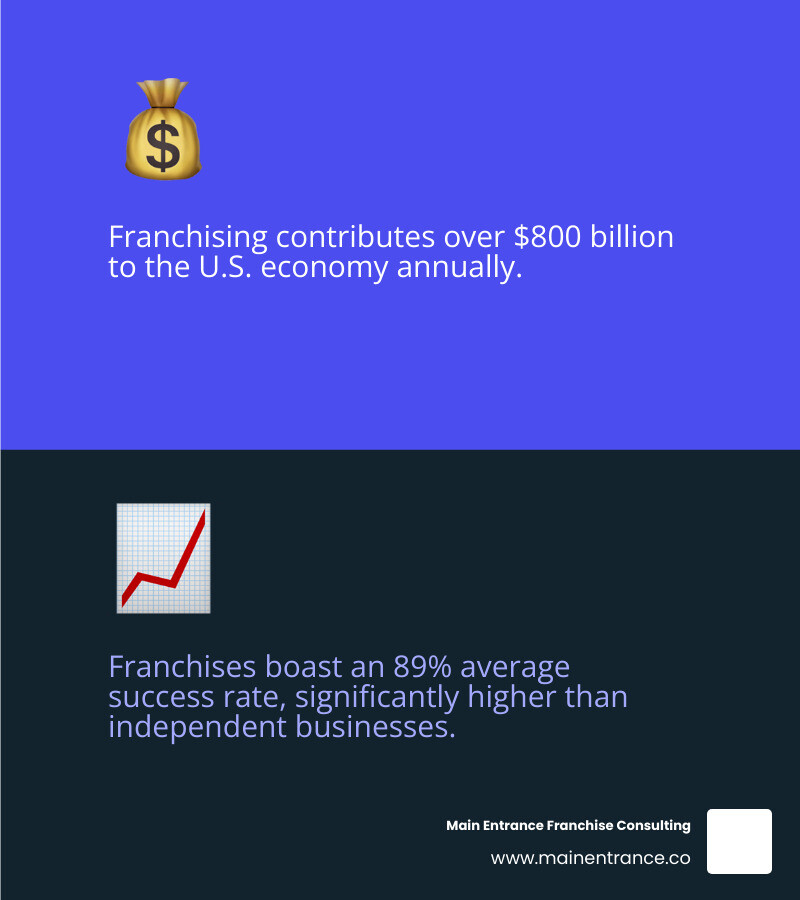
When you buy a franchise USA, you’re tapping into a proven business model that contributes over $800 billion to the U.S. economy annually. With over 770,000 franchised businesses, an 89% average success rate, and more than 3,000 brands to choose from, the opportunity is immense.
The franchise industry supports over 8.5 million jobs and is projected to add 240,000 more this year, making it one of the most stable paths to business ownership in America. Investment ranges from under $10,000 to over $500,000 in popular sectors like food service, home services, and fitness.
However, success isn’t guaranteed. It depends on finding the perfect match between your skills, finances, and the franchise itself. Whether you’re eyeing opportunities in Las Vegas or elsewhere in the United States, understanding the landscape is your first step.
As Max Emma, a Certified Franchise Executive (CFE) who has guided over 100 franchise brands and countless individuals to buy a franchise USA, I’ve seen how the right match creates lasting wealth. Through my experience building a national franchise and founding Main Entrance Franchise Consulting, I’ll walk you through everything you need to know about franchise ownership in America.
Why Bet on a Franchise? Weighing the Pros and Cons
Why do so many entrepreneurs choose to buy a franchise USA? It’s like learning to drive with an experienced instructor versus figuring it out alone—franchising provides a roadmap to success.
The Advantages: Building on a Solid Foundation
When you buy a franchise USA, you purchase a tested and refined business blueprint. The data is clear: franchises have a higher success rate than independent businesses, with studies showing better survival rates.
Key advantages include:
- Proven Business Model: You invest in a system that has already demonstrated success, removing much of the initial guesswork.
- Brand Recognition: An established brand provides instant credibility, which can lead to faster customer acquisition and revenue.
- Ongoing Support & Training: Franchisors provide comprehensive support, from initial training to marketing and operational guidance. They are invested in your success.
- Reduced Risk: These factors combine to lower the inherent risks of starting a business from scratch.
The Disadvantages: The Flip Side of the Coin
Franchising isn’t without its trade-offs. The structure that provides security also creates limitations.
- Restricted Autonomy: If you crave complete creative freedom, the strict brand guidelines of a franchise might feel constraining.
- Ongoing Costs: You’ll pay an initial franchise fee plus ongoing royalty fees, typically 4% to 8% of gross sales, in exchange for the brand and support.
- Contractual Obligations: Long-term agreements (often 10-20 years) govern your operations, limiting your flexibility.
Here’s how franchises stack up against independent startups:
| Feature | Franchise Business | Independent Startup |
|---|---|---|
| Business Model | Proven and tested system | Build from scratch |
| Brand Recognition | Instant credibility | Start at zero |
| Support System | Comprehensive training and ongoing help | Figure it out yourself |
| Success Rates | Higher documented success rates | Lower survival rates |
| Creative Control | Limited by franchise standards | Complete freedom |
| Ongoing Costs | Royalties and fees | No franchise fees |
| Investment Requirements | Varies widely by brand | Often lower initial costs |
The key is understanding that franchising isn’t right for everyone, but for those who value proven systems and ongoing support over complete independence, it can be an excellent path to business ownership. The question isn’t whether franchising is good or bad—it’s whether it’s the right fit for your personality, goals, and financial situation.
Are You the Right Player? Assessing Your Fit for Franchising
Before you look to buy a franchise USA, you need to perform some honest self-reflection. Franchising is a unique path that thrives on structure and following proven systems. Is that the right fit for you?

Ask yourself these key questions:
-
Are you a rule-follower or a maverick? Successful franchisees excel at executing a proven system. If you constantly want to reinvent the wheel, you may find the guidelines restrictive.
-
What is your financial readiness and risk tolerance? You’ll need capital for the initial investment and working capital to sustain the business. While franchises have a high success rate, all business involves risk. Are you comfortable with the financial commitment, including ongoing royalty fees?
-
Do you have strong management skills? You will be responsible for hiring staff, managing cash flow, and handling daily operations. Strong leadership is essential.
-
Are you passionate about the industry? You don’t need to be an expert, but genuine interest in your chosen field will fuel your long-term success and satisfaction.
-
What are your long-term goals? Are you looking for a single-unit business for steady income, or do you want to build a multi-unit empire? Your endgame will help narrow your options.
Answering these questions honestly will determine if franchising is your ideal path. If it is, you can move forward with confidence. Sometimes an outside perspective is invaluable, which is where professional guidance can help. To learn more, see What is a Franchise Consultant? and understand how an advisor can find your perfect match.
The Ultimate Guide to How You Can Buy a Franchise USA
Think of the journey to buy a franchise USA like following a well-marked hiking trail. It might seem intimidating when you’re standing at the trailhead, but each step is clearly mapped out. The best part? Thousands of others have successfully walked this path before you, leaving behind valuable insights to guide your way.

Step 1: Research and Findy
This is the findy phase. Start by assessing what you want from business ownership—a retail storefront, a home-based business, or a service-based operation. Next, research industries that genuinely excite you. With over 3,000 brands in the U.S., you have plenty of options. Use online franchise directories like Franchises for Sale and Franchise Opportunities to filter by industry, investment, and location. Also, consider attending franchise expos to meet franchisors face-to-face and get a feel for their brand culture.
Step 2: Financial Planning and Securing Capital
Understanding the numbers is critical. The total investment includes more than the initial franchise fee. You’ll need to account for:
- Franchise Fee: A one-time payment to join the system.
- Royalties: Ongoing fees, usually a percentage of gross sales.
- Liquid Capital: The cash on hand you need to start.
- Net Worth: Your overall financial standing (assets minus liabilities).
Investment levels vary widely, from under $10,000 for a home-based business to over $1 million for a major restaurant. Most franchisees seek financing. SBA loans are a popular option, as are financing programs offered directly by many franchisors. Navigating this landscape can be complex, which is why we offer personalized guidance. You can find More info about our franchise buying services to see how we help.
Step 3: The Due Diligence Deep Dive
This is the detective phase, where you verify everything. Your most important tool is the Franchise Disclosure Document (FDD), a legal document mandated by the FTC. It contains 23 sections detailing the franchisor’s history, fees, obligations, and financial performance. Item 19, which often contains financial data, is particularly important for evaluating a system’s potential.
Don’t stop at the FDD. Talk to current and former franchisees to get their real-world perspective on support, profitability, and the overall experience. It is also crucial to hire a qualified franchise attorney to review all documents and protect your interests. Finally, analyze your local market to ensure there is demand for the service and understand the competitive landscape.
Step 4: Making Contact and Sealing the Deal
Once your research is complete, it’s time to make it official. You’ll start by contacting the franchisor, which begins a mutual evaluation process. The application will require detailed financial and personal information, as franchisors want partners who align with their brand values. If you’re a good fit, you may be invited to a Findy Day at the corporate headquarters to meet the team.
The final step is signing the Franchise Agreement. After your attorney has reviewed it and you are comfortable with all terms, you will officially become a franchisee, ready to build your business.
Hot Sectors: Exploring Popular Franchise Industries in the USA
The U.S. franchise landscape offers a massive variety of opportunities across more than 300 industries. When you buy a franchise USA, you can choose from established sectors or tap into emerging trends.

Popular Industries to Buy a Franchise USA
Some sectors have proven their worth with consistent demand and profitability:
- Food & Beverage: The undisputed champion, from Quick Service Restaurants (QSR) like McDonald’s to specialized concepts like Smoothie King, this sector is recession-resistant.
- Home Services: This sector has exploded as busy homeowners seek help with cleaning (Maid Brigade), repair (Sir Grout), and general improvements (Kitchen Tune-Up).
- Health & Senior Care: A growing aging population fuels demand for franchises like HomeWell Care Services and FYZICAL Therapy & Balance Centers.
- Fitness Centers: Brands like Planet Fitness prove that people consistently invest in their health.
- Automotive Services: Essential services from brands like Christian Brothers Automotive and Tint World serve a fundamental need for car owners.
- Pet Care: As pets become family, mobile concepts like Zoomin Groomin offer convenient, professional services.
You can explore a full range of Popular Franchise Opportunities on industry directories.
Emerging Trends and Las Vegas Spotlight
Exciting new trends are reshaping the franchise world, often with lower initial investments:
- Tech-driven franchises like NerdsToGo serve businesses and consumers who need tech solutions.
- Mobile businesses like Travelin’ Tom’s Coffee Truck eliminate overhead and bring services directly to customers.
- Healthy living concepts extend beyond gyms to include healthy vending (HealthyYOU) and specialized food options.
- Experiential retail like Shot of Art creates memorable experiences that online shopping can’t match.
Las Vegas is a unique microcosm of these opportunities. Its tourism-driven economy and growing local population create demand across nearly every franchise category, especially service-based and experiential concepts. Nevada’s dynamic market provides fertile ground for growth, and you can explore specific Franchises for Sale in Nevada to find local opportunities.
Frequently Asked Questions about Buying a Franchise in the USA
When considering whether to buy a franchise USA, prospective owners often have the same key questions. Here are answers to the most common ones.
How much does it cost to buy a franchise in the USA?
The investment range is enormous. Low-cost franchises, such as home-based or mobile services, can start around $10,000. Many popular service and retail franchises fall into the mid-range of $50,000 to $250,000. On the high-investment end, major restaurant chains like McDonald’s can require $500,000 or more.
The initial franchise fee is just the start. You must also budget for ongoing royalties (typically 4-6% of gross sales), startup costs for equipment and inventory, and sufficient working capital to operate until you become profitable.
What is a Franchise Disclosure Document (FDD) and why is it important?
The FDD is a comprehensive legal document that franchisors must provide at least 14 days before you sign a contract or pay any money. It’s your primary due diligence tool.
The FDD contains 23 specific sections covering the franchisor’s history, fees, legal issues, and your obligations. Item 19 is particularly valuable, as it often contains Financial Performance Representations showing how existing franchisees have performed. Reading the FDD thoroughly, preferably with a franchise attorney, gives you a clear roadmap of the opportunity and protects you from costly mistakes.
Can a non-US citizen buy a franchise in the USA?
Yes, absolutely. The United States welcomes foreign investment, and many international entrepreneurs buy a franchise USA as a path to living and working in the country.
- The E-2 investor visa is the most common route for citizens of treaty countries. It requires a substantial investment in a U.S. business and is renewable as long as the business operates successfully.
- The L-1 visa is for existing business owners expanding their foreign company to the U.S. through a franchise.
- The EB-5 program offers a path to permanent residency (a green card) with a larger investment ($800,000+) that creates at least 10 U.S. jobs.
Navigating immigration law and franchising simultaneously can be complex. We recommend working with an immigration attorney and an experienced franchise consultant. Our team understands these unique challenges. Learn more about the Advantages of Working with a Certified Franchise Executive (CFE).
Conclusion: Are You Ready to Place Your Bet on a US Franchise?
The journey to buy a franchise USA isn’t just about starting a business—it’s about investing in your future with a safety net that independent startups simply can’t offer. You’re not gambling with your life savings; you’re making a calculated investment in a system that’s already proven it works.
Throughout this guide, we’ve explored the compelling numbers that make franchising so attractive. With an 89% success rate compared to just 28% for independent businesses, franchising clearly stacks the odds in your favor.
But here’s what I’ve learned from helping over 100 franchise brands and countless individuals: success isn’t automatic. It comes from doing your homework, understanding your own strengths and limitations, and finding that perfect match between who you are and what the franchise needs.
The research phase matters. The due diligence deep dive is crucial. That Franchise Disclosure Document (FDD) isn’t just paperwork—it’s your roadmap to understanding exactly what you’re getting into. And those conversations with existing franchisees? They’re worth their weight in gold.
Whether you’re eyeing opportunities in the busy markets of Las Vegas or considering the vast landscape of possibilities across America, the fundamentals remain the same. Know yourself, know the opportunity, and get professional guidance to bridge any gaps in your understanding.
At Main Entrance Franchise Consulting, we’ve built our entire approach around one simple belief: your success is our success. That’s why we offer expert guidance with no upfront costs and flexible compensation models that align our interests with yours. We’re not here to sell you on any particular franchise—we’re here to help you find the one that’s right for you.
The franchise industry continues to evolve, with emerging trends in technology, mobile services, and experiential retail creating new opportunities every year. For international investors, pathways like the E-2 visa make American franchise ownership not just a business opportunity, but a gateway to the American dream itself.
So, are you ready to place your bet on a U.S. franchise? If you’ve made it this far, you’re already showing the kind of thorough, research-driven approach that successful franchisees share. The question isn’t whether franchising works—we know it does. The question is whether it works for you.
Ready to explore E-2 visa franchise opportunities? Let’s start building your business dream together, one informed decision at a time.