

Why CFE Certification is the Gold Standard for Fraud Professionals
CFE certification is the premier credential for professionals fighting fraud. As global fraud evolves, organizations rely on Certified Fraud Examiners (CFEs) to protect their businesses from major financial losses.
Quick CFE Certification Overview:
- What it is: Professional credential from the Association of Certified Fraud Examiners (ACFE)
- Core expertise: Fraud prevention, detection, investigation, and deterrence
- Eligibility: Bachelor’s degree + 2 years relevant experience (or equivalent points)
- Exam: Four sections covering Financial Transactions, Investigation, Law, and Fraud Prevention
- Cost: $195 annual membership + $450 exam fee
- Earning boost: CFEs earn 32% more than non-certified colleagues
- Recognition: Valid in over 150 countries with 95,000+ global members
The CFE credential signifies the highest standard of expertise, combining knowledge of complex financial transactions with investigative skills, legal understanding, and fraud prevention strategies. This unique skill set makes CFEs invaluable across all industries.
CFEs are trained to identify warning signs, implement prevention programs, and create anti-fraud cultures. With fraud losses climbing globally, the demand for qualified CFEs is higher than ever.
I’m Max Emma, a Certified Franchise Executive (CFE) and franchise consultant. My experience has shown me how the right credential can transform careers. Let’s explore why the CFE designation is essential for fraud professionals.
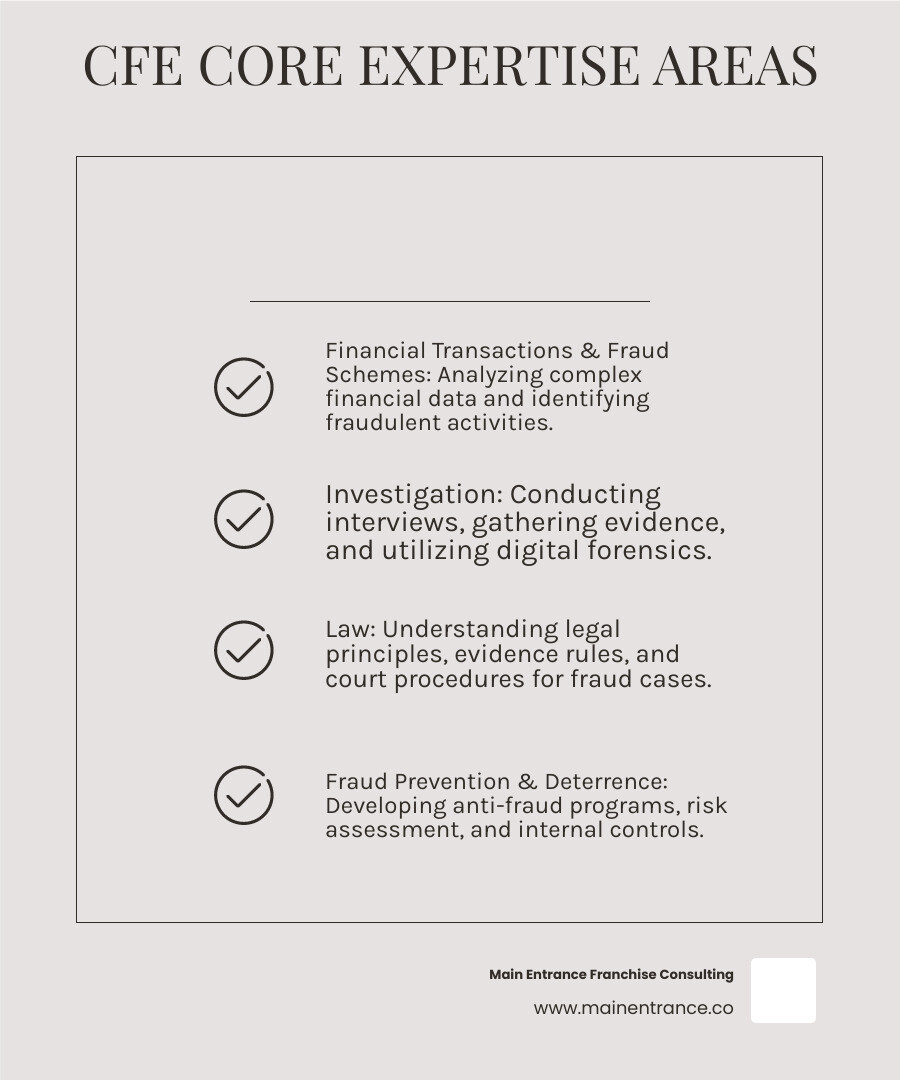
What is a Certified Fraud Examiner (CFE) and Why Does It Matter?
A Certified Fraud Examiner (CFE) is one of the most trusted lines of defense against the billions of dollars lost to fraud each year. A CFE has earned a prestigious credential from the Association of Certified Fraud Examiners (ACFE), proving a unique skill set combining financial expertise, investigative prowess, and legal knowledge. They are financial detectives trained to catch criminals and prevent fraud before it happens.
The credential’s global recognition is a key feature. With over 95,000 ACFE members in more than 150 countries, the CFE designation carries weight worldwide, acting as a passport to professional credibility.

The Core Skills of a CFE
What makes a CFE so effective at fighting fraud? It comes down to mastering four critical areas.
CFEs are experts at analyzing complex financial transactions, spotting patterns that reveal embezzlement, money laundering, or other schemes in financial records. Their investigative techniques include conducting effective interviews, gathering court-admissible evidence, and using digital forensics tools. A deep understanding of legal principles is critical, as CFEs learn the rules of evidence, court procedures, and legal frameworks to ensure their investigations can lead to prosecutions. Finally, CFEs excel at fraud risk management, helping organizations build preventative systems by assessing vulnerabilities and designing anti-fraud programs.
Modern CFEs also leverage data analysis to spot anomalies in massive datasets and use advanced interviewing skills to get to the truth.
Key Benefits of Earning the CFE Credential
How will CFE certification improve your career?
Increased earning potential is a major benefit. CFEs consistently earn about 32% more than their non-certified colleagues, a salary boost that can significantly impact your financial future.
Career advancement is more achievable with a CFE credential. Organizations seek certified professionals for senior roles, as the credential signals trusted, specialized knowledge.
Earning and maintaining the CFE leads to improved expertise. You join a continuous learning community, staying current with the latest fraud schemes and prevention strategies.
Global network access is another key benefit. The ACFE community of 95,000+ professionals and 200+ local chapters is invaluable for career opportunities, knowledge sharing, and support.
Professional credibility is instantly established. In a field built on trust, the CFE designation signals your expertise and high ethical standards to clients, employers, and legal professionals.
For more insights into how professional expertise can transform careers, you might find our perspective on professional expertise helpful. Just as franchise consulting requires specialized knowledge and credentials, the fraud examination field rewards those who invest in proven expertise.
The Path to CFE Certification
The journey to become a Certified Fraud Examiner is a clear, structured process. It’s a path that demands dedication but promises significant rewards.

Eligibility Requirements for the CFE Certification
The ACFE has established specific criteria to ensure candidates have the necessary foundational knowledge and experience.
- ACFE Membership: You must be an Associate member of the ACFE, which costs $195 annually.
- Education Requirements: A bachelor’s degree (or equivalent) is generally required and typically satisfies the 40 points needed for the exam. A master’s degree adds five points, while each year of full-time education without a degree is worth 10 points.
- Professional Experience: A minimum of two years of relevant professional experience is required in fields like accounting, auditing, criminology, or law.
- Points-Based System: The ACFE uses a point system to evaluate eligibility. You need 40 points to sit for the exam and 50 points to be certified, awarded based on education and professional experience.
We highly recommend reviewing the official eligibility requirements directly on the ACFE website to ensure you meet all criteria.
Breaking Down the CFE Certification Exam
The CFE exam is a comprehensive assessment of your knowledge across four critical areas of fraud examination. The exam has four sections, each a two-hour, 100-question multiple-choice test. You have 60 days to pass all four parts with a score of 75% or higher on each.
- Financial Transactions and Fraud Schemes: Covers fraudulent financial transactions, including asset misappropriation, financial statement fraud, and corruption, along with relevant accounting and auditing principles.
- Law: Tests knowledge of the legal aspects of fraud, including criminal and civil law, rules of evidence, and the rights of the accused and accuser.
- Investigation: Focuses on investigative methods, including interviewing, gathering information from public records, tracing illicit transactions, and evaluating deception.
- Fraud Prevention & Deterrence: Examines why people commit fraud and how to prevent it, covering topics like corporate governance, anti-fraud controls, and risk assessment.
The exam content is regularly updated to align with the evolving landscape of fraud. For a detailed blueprint, study the CFE Exam Content Outline.
Understanding the Costs
Investing in cfe certification is a cost-effective choice compared to other prominent professional certifications.
Here’s a breakdown of the typical costs involved:
- ACFE Membership (Annual): $195. This is required to be eligible for the exam.
- CFE Exam Fee: $450 (this is the discounted rate for ACFE members).
- Optional Exam Prep Course: While not mandatory, the ACFE offers an official Exam Prep Course for $995. This can be a valuable investment in your success.
To put this in perspective, let’s look at a comparison:
| Credential | Annual Membership (Approx.) | Exam Fee (Approx.) | Prep Course (Optional, Approx.) | Total Initial Investment (Excluding Prep) |
|---|---|---|---|---|
| Certified Fraud Examiner (CFE) | $195 | $450 | $995 | $645 |
| Certified Public Accountant (CPA) | Varies by state/jurisdiction | $900 – $1,200 | $1,500 – $3,000+ | $900 – $1,200 |
| Certified Internal Auditor (CIA) | $200 – $300 | $1,000 – $1,500 | $1,000 – $2,000 | $1,200 – $1,800 |
| Certified Financial Planner (CFP) | $395 | $825 | $1,000 – $2,000+ | $1,220 |
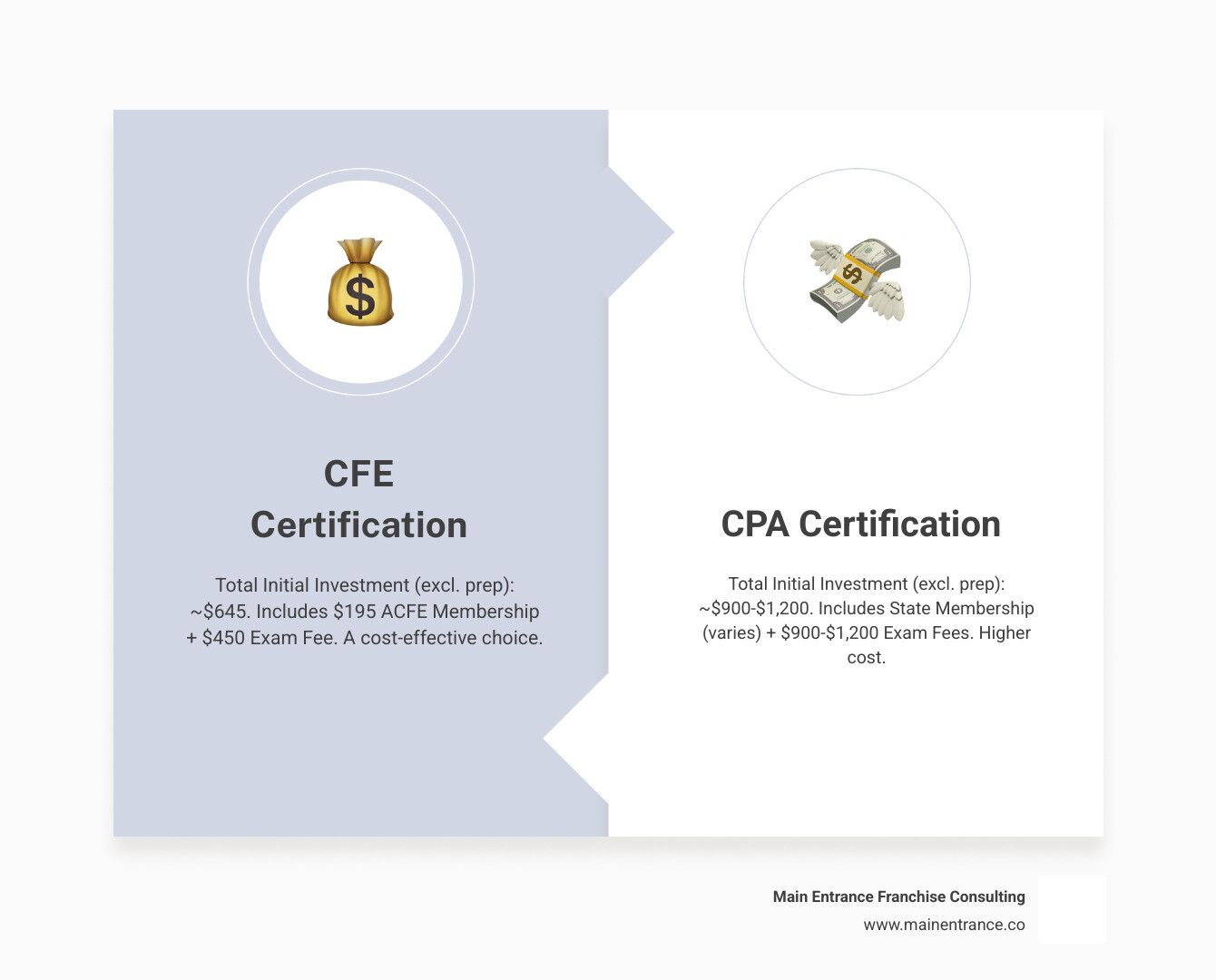
The CFE exam fee is significantly lower than for other credentials like the CPA, making cfe certification an accessible, high-value investment for anti-fraud professionals.
Preparing for and Maintaining Your CFE Credential
Earning your cfe certification requires dedication and a solid plan. Passing the exam is just the beginning of a lifelong commitment to staying current in the evolving world of fraud prevention.

Thorough preparation is critical for the four comprehensive exam sections. With the right approach and resources, you can set yourself up for success.
Proven Strategies to Prepare for the CFE Exam
There are several proven strategies that can help you succeed:
- Create a realistic study schedule. Dedicate eight to ten weeks for consistent study. Use the CFE Exam Content Outline as your roadmap.
- Use the Fraud Examiners Manual. This comprehensive resource is the most authoritative source for all exam topics. Many candidates create notes and flashcards from it.
- Consider the CFE Exam Prep Course for a structured, self-study option. It includes pre-assessments, lessons, and review sessions to guide you through each section.
- Form or join a study group. Collaborating with other candidates helps you gain different perspectives, stay motivated, and build lasting professional relationships.
- Join the ACFE’s 90-Day Challenge for a structured study plan with tips and check-ins to keep you on track and connected with other candidates.
- Take practice tests. They are crucial for identifying weak spots, getting comfortable with the format, and learning to manage your time effectively.
After the Exam: CPE and Maintaining Your Status
After passing the exam and earning your cfe certification, you must meet ongoing requirements that improve the credential’s value.
The ACFE requires 20 CPE credits annually to maintain your certification. This ensures CFEs stay at the cutting edge as fraud schemes and technologies evolve.
At least 10 credits must relate directly to fraud detection and deterrence, keeping you current on the latest trends and techniques. The other 10 can cover related areas like accounting or auditing.
Ethics training is mandatory, with at least two credits required annually. This requirement underscores the CFE’s role as a guardian of integrity.
Maintain records of your CPE credits for three years, as the ACFE conducts compliance audits. Staying organized is essential.
This commitment to continuous learning is what makes the CFE credential so respected. For details, see the ACFE’s continuing professional education requirements.
In a field where the bad guys are constantly innovating, staying current isn’t optional – it’s essential.
Career Prospects and Salary Expectations for CFEs
The demand for CFEs is stronger than ever. As fraud schemes become more sophisticated, organizations need professionals who can stay one step ahead, creating a favorable job market for those with cfe certification.
Organizations with CFEs uncover fraud 40% sooner than those without, representing millions in potential savings and preventing significant damage.

The CFE credential is highly versatile. Opportunities are abundant across corporations, government agencies, law firms, and non-profits, for both in-house experts and external consultants.
Common Career Paths for CFEs
The career paths for CFEs are diverse and rewarding. Some of the most popular options include:
Forensic Accountants dive deep into financial discrepancies, often serving as expert witnesses. Internal Auditors with CFE credentials bring a unique fraud-focused perspective to their assessments.
Fraud Investigators are the frontline warriors against employee theft and financial manipulation. Risk Managers take a strategic approach, developing strategies to prevent fraud before it happens.
Compliance Officers ensure organizations build robust anti-fraud systems. Law Enforcement Agents with cfe certification specialize in financial crimes, cybercrime, and money laundering.
Anti-Money Laundering (AML) Officers focus on identifying suspicious transactions, while Corporate Security Managers protect company assets. The ACFE Job Board is constantly updated with new opportunities across all these specializations.
Salary Insights and Earning Potential
The financial benefits of cfe certification are substantial and well-documented.
CFEs consistently earn 25 to 40 percent more than their non-certified colleagues. Recent studies show a median salary increase of 32% for certified professionals, reflecting the specialized nature of their work.
In the United States, CFE salaries typically range from $85,000 to $130,000 annually, though several factors influence this. Experience level, industry choice, geographic location, and your specific role all impact earnings.
The investment in cfe certification offers one of the best returns on investment in professional development, considering the modest cost against the substantial salary increase.
Frequently Asked Questions about the CFE Credential
Here are answers to the most common questions about cfe certification.
Is the CFE certification worth it for career advancement?
Absolutely. For anyone in an anti-fraud field, cfe certification is one of the smartest career investments.
It demonstrates expertise in a critical, specialized field. The credential proves you have specific knowledge to spot fraud and implement prevention strategies, setting you apart from colleagues with more general skills.
The financial benefits are significant. CFEs consistently earn 32% more than non-certified peers, which can amount to hundreds of thousands of dollars over a career.
The CFE opens doors to senior roles in risk management, compliance, and internal audit. Employers seek out CFEs for leadership positions because their expertise can prevent costly fraud losses.
Employers highly value CFEs for their ability to uncover fraud faster and implement effective prevention measures.
How long does it take to become a CFE?
The eligibility phase typically takes about six years, which includes a four-year bachelor’s degree and two years of relevant professional experience. If you’re already in a related field, you may be partway there.
Once eligible, exam preparation usually takes 8-10 weeks of dedicated study to cover all four sections thoroughly.
You have a flexible 60-day window to complete all four parts of the exam once you begin.
While the path requires commitment, you build valuable experience along the way, combining knowledge with real-world practice.
What is the role of the ACFE in the certification process?
The Association of Certified Fraud Examiners (ACFE) is the global authority that makes the cfe certification meaningful and respected worldwide.
As the sole administering body, the ACFE controls the entire certification process, from setting eligibility requirements to developing the exam. This ensures consistent global standards and gives the credential its international value.
The ACFE sets and enforces a Code of Professional Ethics that all CFEs must follow. This commitment to integrity is a key reason employers trust the credential.
The ACFE provides ongoing training and resources, including continuing professional education and research, to keep CFEs at the top of their field throughout their careers.
The ACFE fosters a global community of over 95,000 professionals through 200+ local chapters, facilitating networking, knowledge sharing, and collaboration. This community is invaluable for career development.
Conclusion: Lift Your Career with Certified Expertise
CFE certification is more than a credential; it’s a gateway to an elite group of professionals who protect businesses and communities worldwide.
CFEs earn 32% more than their non-certified colleagues, work in diverse roles, and are respected as experts. Beyond the financial rewards, there is deep satisfaction in using your skills to prevent devastating financial crimes.
The journey to becoming a CFE requires dedication, from meeting eligibility requirements to committing to ongoing professional development. Thousands have found this to be one of the most rewarding investments of their careers.
The CFE credential’s value lies in its comprehensive approach, developing expertise in financial analysis, investigative techniques, legal principles, and fraud prevention strategies. This well-rounded skill set makes you valuable to employers and opens doors to leadership roles.
The ACFE’s high standards ensure your cfe certification carries global weight. You’ll join a community of over 95,000 members in 150+ countries dedicated to fighting fraud.
At Main Entrance Franchise Consulting, we understand the power of certified expertise firsthand. Just as CFEs bring specialized knowledge to combat fraud, our team brings certified expertise to help clients steer the complex world of franchising. We’ve seen how the right credentials and knowledge can transform careers and create opportunities that seemed impossible before.
Whether you’re just starting your career in fraud examination or looking to take your existing skills to the next level, the CFE credential offers a clear path forward. It’s an investment in yourself, your earning potential, and your ability to make a meaningful impact in the fight against fraud.
Ready to explore how certified professionals can lift your business success? Find the advantages of working with a Certified Franchise Executive (CFE) and see how expertise makes all the difference.