

Your Pathway to U.S. Business Ownership
An E-2 Visa Franchise is a strategic pathway for foreign nationals from treaty countries to live and work in the United States by investing in and managing a franchise business. This non-immigrant visa allows qualified investors, along with their spouses and minor children, to relocate to America based on a substantial investment in a bona fide U.S. enterprise.
Quick Overview: What You Need to Know
- Who Qualifies: Citizens from one of 80+ E-2 treaty countries
- Investment Range: Generally $100,000–$300,000+ depending on franchise type
- Business Type: Active franchise operations requiring hands-on management
- Family Benefits: Spouse can work, children can attend school
- Duration: Initial 2-year stay, renewable indefinitely
- Key Advantage: Franchises offer proven systems that strengthen visa applications
Since 1952, the E-2 visa has helped foreign entrepreneurs establish businesses in the United States. In fiscal year 2023 alone, nearly 54,000 E-2 visas were issued—a 20% increase from the previous year. This growth reflects both the program’s value to the U.S. economy through job creation and its appeal to international investors seeking a structured entry point to American business ownership.
Why franchising works so well for E-2 visas: Immigration officials favor established business models with documented track records. Franchises come with detailed business plans, financial projections, and operational support—exactly what you need to demonstrate that your investment is substantial, your business is legitimate, and your venture will succeed. Rather than building a business from scratch and proving every assumption, you’re investing in a system that’s already been tested and refined.
The process isn’t simple, but it’s navigable with the right guidance. You’ll need to meet specific investment thresholds, demonstrate active management involvement, and show that your business will generate more than just a minimal living income. You’ll also need to work with immigration attorneys, understand complex legal documents, and coordinate timing between your franchise purchase and your visa application.
I’m Max Emma, a Certified Franchise Executive (CFE) who has guided countless entrepreneurs through the franchise findy process, including many who successfully secured their E-2 visas. Through Main Entrance Franchise Consulting, I help match international investors with E-2 Visa Franchise opportunities that align with both their business goals and immigration requirements.
Why a Franchise is Your Strongest Path to an E-2 Visa
Choosing a franchise for your E-2 visa application offers significant strategic advantages compared to the daunting task of starting a new business from scratch. When you invest in a franchise, you’re not just buying a business; you’re buying into a proven system, which can significantly streamline your E-2 visa application process and increase your chances of success.
The Benefits of a Proven Business Model
Imagine trying to convince immigration officials that a brand-new business idea, with no track record, no established customers, and no operational history, is a “bona fide enterprise” that will generate more than a minimal living. It’s a tough sell! This is where a E-2 Visa Franchise truly shines.

Franchises offer a blueprint for success. They come with proven systems, established brand recognition, and a lower perceived risk in the eyes of U.S. immigration authorities. You benefit from the franchisor’s extensive experience, receiving comprehensive training, ongoing support, and access to established best practices. This “turnkey opportunity” means you can often launch your business much faster than if you started independently.
The Franchise Disclosure Document (FDD), a comprehensive legal document provided by franchisors, contains over 100 pages of relevant data detailing the franchisor’s proven track record, financial health, and operational procedures. This document is invaluable for strengthening your E-2 visa application, as it provides concrete evidence that your chosen business is legitimate and well-structured.
We at Main Entrance Franchise Consulting specialize in guiding you through this process, helping you find a franchise that not only fits your goals but also meets the stringent requirements of the E-2 visa. You can learn more about our comprehensive Franchise Buying services.
Top Franchise Industries for E-2 Visa Success
While a wide variety of franchise categories can fit E-2 investors, certain industries naturally align well with the E-2 visa’s requirements for active management, job creation potential, and stable growth. These often include:
- Home Services: Such as cleaning, landscaping, or repair services. These businesses typically have lower overheads and can be scaled effectively.
- Senior Care: With the U.S. population aging, especially in states like Texas, California, and Florida where one-quarter of all people aged 65 and older reside, the demand for in-home care services is booming. Brands like Homewatch Caregivers, for example, have franchisees reaching median gross revenues of $1.4 million by year four, tapping into this growing market.
- Business Services: Consulting, marketing, or staffing franchises provide essential services to other businesses.
- Children’s Education: Tutoring centers or enrichment programs are often seen as community-contributing businesses with predictable revenue models.
- Quick-Service Restaurants (QSRs): While requiring higher investment, QSRs offer established brand recognition and clear operational models.
The U.S. short-term rental market, for instance, reached $42.1 billion in 2024 and is projected to exceed $103 billion by 2033, indicating strong potential for related service franchises. Many of these categories offer flexibility, scalability, and community involvement, making them ideal for those exploring E-2 Visa Franchise opportunities.
We believe in helping you find a business that offers not just financial returns, but also personal satisfaction. Find more about the Freedoms of Franchise Ownership that motivate successful franchise owners.
Potential Challenges and How to Steer Them
While franchises offer numerous advantages, it’s important to be aware of potential drawbacks. Franchising involves an agreement with a franchisor, which means less autonomy compared to an independent business. You’ll adhere to operational guidelines, marketing strategies, and often pay ongoing royalty fees. This structure, while beneficial for visa purposes, isn’t for every entrepreneurial spirit.
Another challenge is that not all franchisors are set up or willing to work with E-2 visa candidates. Some may have policies restricting international franchisees or prefer U.S. citizens/residents. Thorough due diligence is paramount. This includes understanding the franchisor’s guidelines, financial health, and their experience with E-2 investors.
Working with an experienced franchise consultant is crucial here. A franchise consultant can help identify franchise options suited for E-2 candidates based on your skills, interests, and budget, navigating these potential pitfalls on your behalf. They can also help you build a team that includes an immigration attorney to provide legal guidance and manage the E-2 visa application process, and a franchise attorney to review the complex franchise agreements.
Meeting the Core Requirements for Your E-2 Visa Franchise
Securing an E-2 visa through a franchise investment requires meeting specific legal and financial criteria set forth by U.S. immigration law. These requirements ensure that your investment is genuine, substantial, and contributes positively to the U.S. economy.
Key Eligibility Criteria for the Investor
To be eligible for an E-2 visa, you, as the investor, must meet several fundamental requirements:
- Nationality: You must be a national of a country that holds a treaty of commerce and navigation with the United States. Major eligible countries include the United Kingdom, Germany, Japan, South Korea, and many others. It’s essential to check the current treaty country list on the State Department website for eligibility, as this list can be updated.

-
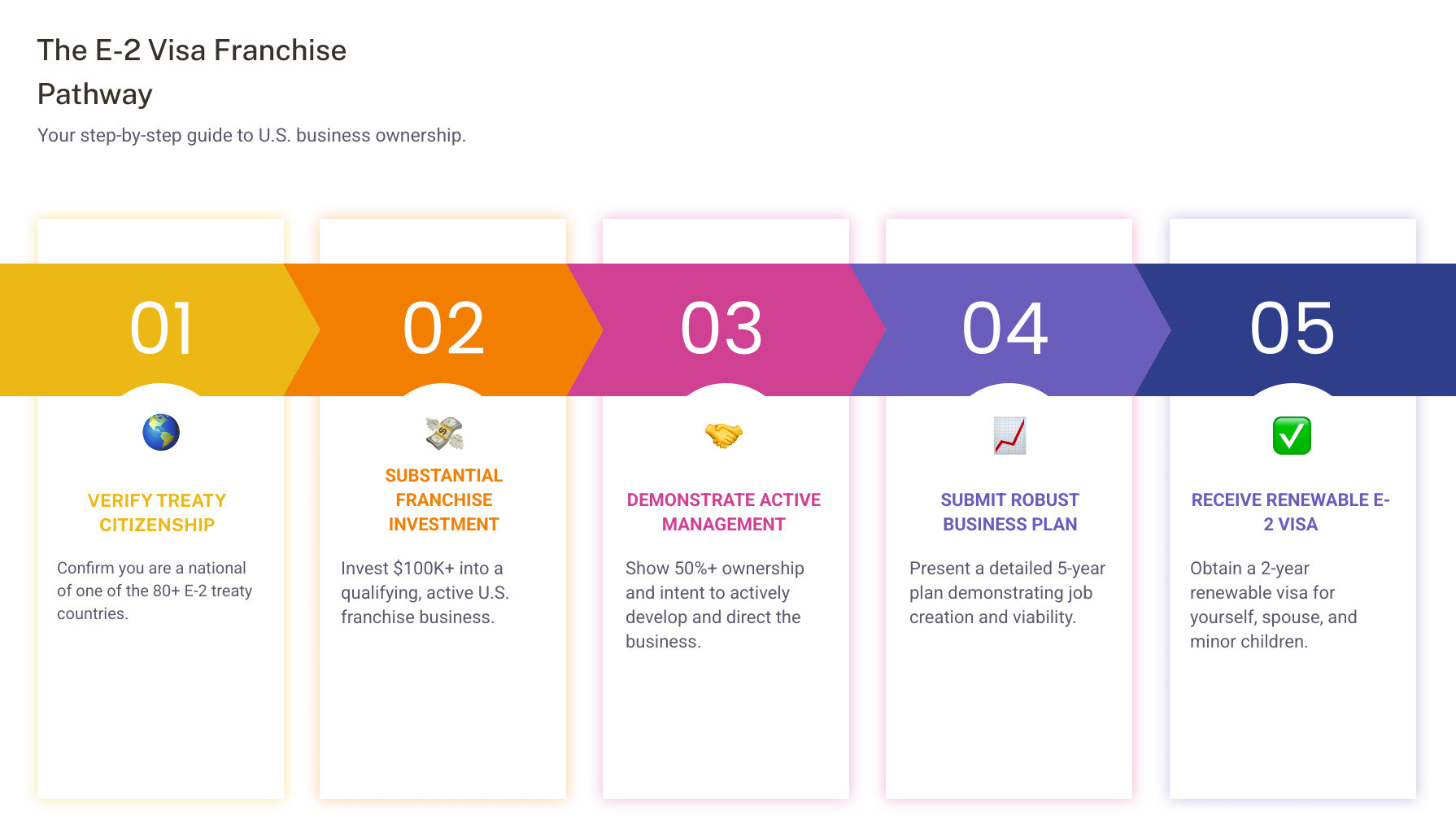
Ownership and Control: You must have invested, or be actively in the process of investing, a substantial amount of capital in a bona fide U.S. enterprise. This typically means owning at least 50% of the enterprise or possessing operational control through a managerial position. Your role must be to develop and direct the investment enterprise.
-
Bona Fide Enterprise: The business must be a real, active, and operating commercial or entrepreneurial undertaking that produces services or goods for profit. It cannot be a passive investment, such as undeveloped land or stocks held for speculation.
-
Not a Marginal Business: The business must have the present or future capacity to generate more than a minimal living income for you and your family. In other words, it must be profitable enough to support you and contribute to the U.S. economy. For new enterprises, there’s often an expectation that they will become profitable within five years.
Your Guide to a ‘Substantial’ E-2 Visa Franchise Investment
One of the most critical aspects of an E-2 visa application is demonstrating a “substantial” investment. While there’s no official minimum dollar amount, the investment must be significant in proportion to the total cost of purchasing or establishing the enterprise. Most successful E-2 Visa Franchise applications involve investments of at least $100,000, with many investing $150,000 to $300,000 or more.
The concept of “substantial” is evaluated using a proportionality test: the lower the cost of the enterprise, the higher, proportionately, your investment must be. For instance, a business costing $100,000 might require nearly 100% of that to be invested, whereas a $1 million business might only require 50% to be considered substantial. The investment must be “at risk,” meaning it’s irrevocably committed to the business and subject to partial or total loss if the business fails. Funds held in escrow are acceptable only if the sole contingency for their release is visa approval.
Your investment typically covers:
- Franchise Fees: The initial payment to the franchisor for the right to operate the business.
- Startup Costs: Equipment, inventory, leasehold improvements, initial marketing, and legal/professional fees.
- Working Capital: Sufficient funds to cover operational expenses until the business becomes profitable.
To illustrate typical investment ranges, consider the following:
| Business Type | Typical E-2 Investment Range | Percentage of Total Cost (Example) |
|---|---|---|
| Service-Based / Consulting | $60,000 – $150,000 | 70% – 100% |
| Brick-and-Mortar (e.g., Restaurant, Retail) | $150,000 – $500,000 | 50% – 70% |
All investment funds must be legally sourced and fully documented with clear trails of transfer.
Bringing Your Family and Understanding the Costs
A wonderful benefit of the E-2 visa is the ability for your family to join you. Your spouse and unmarried children under 21 years of age are eligible for derivative E-2 visas. Importantly, your spouse can apply for work authorization in the U.S., allowing them to work for any U.S. employer. Your children can attend U.S. schools, but they are not authorized to work.
Beyond the business investment itself, there are several fees associated with the E-2 visa application:
- DS-160 Application Fee: Currently $315 (as of 2025).
- Form I-129 (Change of Status): Ranges from $510 to $1,015 if applying from within the U.S.
- Form I-539 (Dependents): $470 for family members applying for change of status.
- Optional Premium Processing: An additional $2,805 for expedited USCIS processing.
- Legal Fees: Typically range from $4,000 to $10,000+ for immigration attorneys.
- Reciprocity Fee: This may apply depending on your country of citizenship. You can check if this fee applies to you by using the U.S. Department of State Reciprocity Tables.
These costs underscore the importance of comprehensive financial planning and working with experienced professionals.
The Step-by-Step Application Process
Navigating the E-2 visa application process can feel complex, but it becomes much clearer when broken down into manageable steps. For a E-2 Visa Franchise, the journey typically involves thorough due diligence, meticulous documentation, and strategic planning.
From Franchise Selection to Visa Petition
Your journey begins with selecting the right franchise. This isn’t just about finding a business you like; it’s about finding one that aligns with E-2 visa requirements and your personal capabilities.
- Franchise Due Diligence: This critical phase involves researching potential franchises, reviewing their Franchise Disclosure Documents (FDDs) in detail, and understanding their business model, financial performance, and support systems. We at Main Entrance Franchise Consulting guide you through this, helping you identify opportunities that are “E-2 friendly.”
- Speaking with Franchisees: A crucial step is to talk with existing franchisees of the brands you’re considering. Their insights into day-to-day operations, franchisor support, and profitability can be invaluable.
- Signing the Franchise Agreement: Once you’ve chosen your franchise, you’ll sign the franchise agreement. This is a legally binding document, and it’s highly recommended to have a franchise attorney review it.
- Securing and Documenting Funds: This is where the “irrevocably committed” and “at risk” investment comes into play. You must demonstrate that your investment funds have been legally sourced and are either spent or contractually obligated to be spent on the business. This means showing bank transfers, purchase agreements, leases, and other financial documents.
Working with a Certified Franchise Executive (CFE) like Max Emma can provide you with an invaluable advantage during this stage. Learn more about the advantages of working with a Certified Franchise Executive (CFE).
Crafting a Winning E-2 Visa Franchise Business Plan
A robust business plan is the backbone of any successful E-2 visa application. For a E-2 Visa Franchise, this task is significantly simplified because the franchisor often provides a wealth of data and a proven model. However, it still needs to be custom to your specific situation and presented in a way that addresses immigration requirements.
Your business plan should include:
- Executive Summary: A concise overview of your business, investment, and qualifications.
- Business Description: Detail the franchise concept, products/services, and target market.
- Market Analysis: Demonstrate a solid understanding of the U.S. market and your franchise’s position within it.
- Operational Plan: Outline how the business will function day-to-day, including your active management role.
- Management Team: Highlight your experience and qualifications to run the business.
- Financial Projections: Provide detailed 5-year financial projections, including startup costs, operating expenses, revenue forecasts, and cash flow analysis. These projections are critical for proving the business is not marginal.
- Job Creation Plan: Even though there’s no specific job creation minimum for the E-2, your plan should show the capacity and intent to hire U.S. workers, contributing to the local economy.
The franchisor’s historical data and operational manuals can be instrumental in creating a credible and convincing business plan for your E-2 visa.
Navigating the Application and Avoiding Common Pitfalls
Once your franchise investment is secured and your business plan is ready, you’ll proceed with the formal visa application. There are two primary pathways:
- Consular Processing: Applying for the E-2 visa at a U.S. consulate or embassy in your home country. This is the most common route.
- Change of Status: If you are already in the U.S. in a lawful nonimmigrant status, you can apply to change your status to E-2 with USCIS.
Typical processing times can vary significantly. Consular processing usually takes 2–12 weeks, while a change of status within the U.S. can take 2–4 months (though premium processing can expedite this to 15 days).
Common reasons for E-2 visa denial when investing in a franchise, and how to avoid them, include:
- Insufficient Investment: Not meeting the “substantiality” requirement. Ensure your investment is proportional and clearly documented.
- Weak Business Plan: Failing to demonstrate profitability, active management, or economic contribution. Leverage franchisor data and work with professionals to create a robust plan.
- Marginal Business: The business appears unable to generate enough income to support you and your family. Your business plan must clearly project growth and profitability.
- Lack of Active Management: Not proving your intent and ability to develop and direct the business. Your role must be clearly defined.
- Unclear Source of Funds: Inability to demonstrate that your investment funds were legally obtained. Keep meticulous records.
Preparing for the consular interview is also vital. Be ready to articulate your business plan, your role, and how your investment will benefit the U.S. economy. For official guidance and forms, always consult USCIS on E-2 Treaty Investors.
Life as an E-2 Franchise Owner: Responsibilities and Future Paths
Once your E-2 visa is approved and you’re operating your franchise in the U.S., your journey continues with ongoing responsibilities to maintain your visa status and potential future pathways to permanent residency.
Ongoing Responsibilities to Maintain Your Status
The E-2 visa is tied to the success and continued operation of your business. To maintain your status, you must:
- Maintain Active Management: You must continue to develop and direct your franchise business. This is not a passive investment visa.
- Maintain Profitability: While short-term fluctuations are understood, your business must remain viable and continue to generate more than a minimal living income.
- File U.S. Taxes: As an E-2 visa holder, you are required to file U.S. federal and state tax returns on all income earned in the U.S.
- Visa Renewals: The E-2 visa can be renewed indefinitely as long as your business remains operational and meets the treaty investor requirements. This usually involves demonstrating the continued viability and active management of your business. Each renewal is typically granted for two years, though the visa stamp itself might be for a longer period depending on your country of citizenship.
- Report Substantive Business Changes: If there are significant changes to your business (e.g., merger, acquisition, change in ownership structure), you must notify USCIS by filing a new Form I-129.
From E-2 Visa to Green Card: Exploring Your Options
The E-2 visa is a non-immigrant visa, meaning it does not directly provide a path to a green card or permanent residency in the United States. However, it can serve as a stepping stone to other immigration categories.
Common transition pathways for E-2 visa holders seeking a green card include:
- EB-5 Immigrant Investor Program: This visa requires a much higher investment (typically $800,000 to $1.05 million, depending on the area) and the creation of at least 10 full-time jobs for U.S. workers. If your franchise grows significantly and meets these criteria, an EB-5 could be an option.
- Employment-Based Green Cards: If your skills are highly sought after, an employer (which could be your own expanded business) might sponsor you for an employment-based green card (e.g., EB-1, EB-2, EB-3).
- Family Sponsorship: If you have a qualifying U.S. citizen or lawful permanent resident family member, they might be able to sponsor you for a green card.
While the E-2 visa offers a fantastic opportunity for living and working in the U.S., planning for long-term residency often involves exploring these additional immigration avenues with the guidance of an experienced immigration attorney.
Frequently Asked Questions about the E-2 Visa Franchise
We often encounter similar questions from aspiring E-2 Visa Franchise owners. Here are some of the most common ones, answered to provide clarity on your journey.
What is the absolute minimum investment for an E-2 visa franchise?
There is no official minimum investment amount set by U.S. immigration law. However, the investment must be “substantial” relative to the total cost of the business, sufficient to ensure its successful operation, and demonstrate your financial commitment. Most successful E-2 visa applications for franchises involve investments of at least $100,000 to $150,000. This amount typically indicates a serious commitment and helps prove that the business is not “marginal” (i.e., it can generate more than a minimal living income for you and your family). For lower-cost businesses, the percentage of the total cost invested needs to be higher.
Can I buy any franchise for an E-2 visa?
No, not every franchise is suitable for an E-2 visa. The franchise must be a real, active, and operating business that you will actively develop and direct. Passive investments, such as simply owning shares in a company without active involvement, do not qualify. Additionally, not all franchisors are willing or equipped to work with E-2 visa candidates, as it can involve specific documentation and timelines. It’s crucial to identify “E-2 friendly” franchises and ensure the franchisor is experienced in this process. Our role at Main Entrance Franchise Consulting is to help you steer this and find franchises that meet both your goals and the visa requirements.
Do I need prior business experience to get an E-2 visa with a franchise?
While having relevant business or industry experience can certainly strengthen your application, it is not a strict requirement for the E-2 visa, especially when investing in a franchise. The franchise model is a key advantage here because franchisors provide comprehensive training, operational manuals, and ongoing support. U.S. immigration officials recognize that these established systems are designed to help new owners, even those without extensive prior experience, succeed. Your business plan should highlight the training and support you will receive from the franchisor, demonstrating your capacity to manage the business effectively.
Start Your Franchise Findy Journey with Confidence
The path to U.S. business ownership through an E-2 Visa Franchise is a structured and powerful one, but it requires careful planning and expert navigation. Understanding the nuances of both franchise selection and visa requirements is critical to your success. At Main Entrance Franchise Consulting, we provide education-first guidance to help you find a franchise that aligns with your investment goals and E-2 visa eligibility, all at no cost to you. Let us help you take the first step toward your American dream with clarity and confidence.