
Why Franchise Business Training Makes or Breaks Your Success
Franchise business training is the structured education and support program that franchisors provide to new franchisees, covering everything from daily operations to brand standards, financial management, and customer service protocols.
Key Components of Franchise Business Training:
- Initial Training: Typically 1-4 weeks covering brand history, operations, and systems
- On-Site Training: Hands-on support at your location with certified trainers
- Ongoing Education: Regular webinars, workshops, and skill updates
- Support Materials: Operations manuals, marketing resources, and technology platforms
- Performance Evaluation: Regular feedback and coaching to ensure success
Here’s the thing about franchising: consistency is the hallmark of a successful franchise. When you order a burger at your favorite restaurant, you expect it to taste the same whether you’re in New York or Nevada. That consistency doesn’t happen by accident – it’s the direct result of comprehensive training programs.
The numbers tell the story. Franchised businesses contribute $670 billion to the U.S. economy, representing 3% of total GDP. With one out of every seven businesses worldwide being a franchise, the stakes for getting training right couldn’t be higher.
But here’s what most people don’t realize: franchise training isn’t just about learning how to flip burgers or answer phones. It’s about creating a replicable business model that works across different markets, different owners, and different circumstances. The best franchise systems understand that when franchisees succeed, everyone wins.
As Max Emma, a Certified Franchise Executive (CFE) and founder of Main Entrance Franchise Consulting, I’ve seen how franchise business training can determine whether a new business thrives or struggles. After building and scaling BooXkeeping into a national franchise system, I’ve learned that the quality of your training program directly impacts everything from franchisee satisfaction to system-wide profitability.
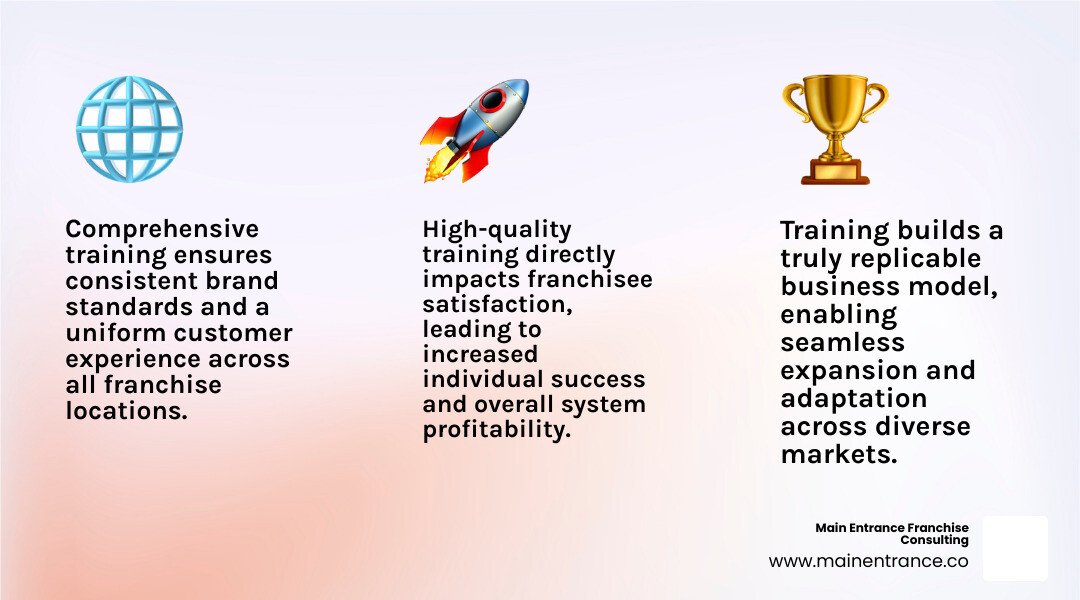
Why Comprehensive Training is a Win-Win (For Everyone)
Here’s something I’ve learned after years in the franchise world: franchise business training isn’t just a nice-to-have feature. It’s the secret sauce that makes or breaks the entire system. And the beautiful thing? When it’s done right, absolutely everyone comes out ahead.

Think about it from the franchisee’s perspective first. You’re investing your hard-earned money into a business opportunity. The last thing you want is to figure everything out through expensive trial and error. Comprehensive training gives you reduced risk and a clear roadmap to success. Instead of stumbling around in the dark, you get access to a proven system that’s already been tested and refined.
But the benefits flow both ways. Franchisors know their success depends entirely on their franchisees thriving. Every well-trained franchisee becomes a brand ambassador who delivers consistent customer experiences. This creates stronger brand reputation and makes the entire system more valuable.
The magic happens when you achieve true brand consistency. Customers know exactly what to expect, whether they visit your location in Maine or Montana. That predictability builds trust, and trust builds loyal customers who keep coming back.
The Primary Purpose of Franchise Business Training
Let’s cut to the chase: the main goal of franchise business training is equipping franchisees for success. But what does that really mean?
It starts with duplicating the brand in every single location. This isn’t about creating robots – it’s about ensuring that the core elements that make the brand special are preserved and delivered consistently. Whether it’s the way you greet customers, prepare products, or handle complaints, training ensures everyone’s singing from the same songbook.
Protecting the brand is equally crucial. One poorly run location can damage the reputation of hundreds of other franchisees. Training acts as a quality control system, making sure every franchisee understands not just what to do, but why it matters.
The best training programs focus on laying a solid foundation that covers everything from daily operations to brand positioning. When franchisees truly understand the brand’s values and mission, they become invested partners rather than just operators following a manual.
This deeper understanding creates franchisee commitment. And committed franchisees? They’re the ones who go above and beyond to make their locations shine.
How Training Drives Franchise System Growth
Here’s where things get really interesting. Effective franchise business training creates a ripple effect that benefits the entire system.
Well-trained franchisees achieve higher success rates. And when word gets out that franchisees in a particular system are thriving, it creates a stronger brand reputation that attracts better candidates. Nobody wants to join a franchise where operators are struggling or failing.
This positive reputation becomes a powerful tool for attracting better candidates – people with more experience, better financing, and stronger business skills. These high-quality franchisees are more likely to succeed, which strengthens the cycle even further.
The result is improved scalability. When you have systems and training that consistently produce successful operators, expanding into new markets becomes much easier and less risky.
And let’s talk about the bottom line: financial performance. Well-trained franchisees generate higher revenues, which means more royalty income for franchisors and better profit margins for everyone involved. It’s not just about making money – it’s about creating increased profitability for all parties that makes the entire franchise relationship sustainable and rewarding.
This is why the most successful franchise systems invest heavily in their training programs. They understand that every dollar spent on education comes back multiplied through better performance, stronger growth, and happier franchisees.
The Core Components of Franchise Business Training
So, what should you actually expect when you start on your franchise business training journey? It’s one of the most common questions we hear from prospective franchise owners, and for good reason.

Here’s the reality: franchise business training is almost always mandatory. Think about it from the franchisor’s perspective – they’ve spent years perfecting their system, and they need to make sure you can execute it properly. Your success is their success, after all.
But here’s where things get interesting. Training programs vary dramatically from one franchise to another. Some last just a few weeks, while others stretch over several months. The cost structure differs too – some franchisors roll training costs into your initial franchise fee, while others charge separately. Location can range from intensive group sessions at corporate headquarters to personalized one-on-one training right at your future business location.
This is exactly why due diligence becomes your best friend. Before you sign anything, dive deep into that Franchise Disclosure Document (FDD). It’s your roadmap to understanding exactly what training you’ll receive. Don’t hesitate to ask the franchisor detailed questions about their expectations and training methods.
Here’s a pro tip from our years of experience: reach out to current franchisees and ask about their training experience. They’ll give you the unvarnished truth about what works, what doesn’t, and how well the training prepared them for real-world challenges.
The Anatomy of Effective Training: From Classroom to On-Site
The best franchise business training programs don’t rely on just one teaching method. Instead, they blend different approaches to match how people actually learn. You’ll typically encounter a mix of classroom instruction, hands-on field training, and flexible virtual learning.
| Training Type | Duration | Location | Cost | Learning Objectives |
|---|---|---|---|---|
| Classroom/HQ | 1-4 weeks | Franchisor HQ/Virtual | Often included in fee or separate | Brand history, operational procedures, financial management, marketing strategies, HR, compliance, theoretical knowledge |
| On-Site/Field | Varies | Franchisee’s location | Often included | Hands-on application, technical operations, customer service, employee training, local market adaptation, practical skills |
| Virtual/At-Home | Flexible | Anywhere with internet | Often included | Self-paced learning, specialized modules, policy updates, supplemental knowledge, ongoing education, flexibility |
Classroom training usually happens at the franchisor’s headquarters or through virtual sessions. This is where you’ll absorb the brand’s history, learn operational procedures inside and out, understand reporting requirements, and grasp the core principles that make the business work. Think of it as your intensive boot camp in brand knowledge and business fundamentals.
The travel component can be significant, so make sure you factor in time away from home and any associated costs. Some franchisors have moved to virtual classroom sessions, which can be just as effective while being more convenient for busy entrepreneurs.
Field training is where theory meets reality. A certified trainer comes to your location to work alongside you in your actual business environment. You’ll practice customer interactions, perfect product delivery, and fine-tune your daily operations. This hands-on approach helps you troubleshoot real scenarios and build confidence before you’re flying solo.
Virtual and at-home training has revolutionized how franchisors deliver ongoing education. These self-paced modules let you learn specialized skills, complete policy updates, and access supplemental training materials on your own schedule. It’s particularly valuable for busy franchise owners who need flexibility in their learning approach.
What’s Actually on the Syllabus?
The curriculum for franchise business training is designed to transform you from a hopeful entrepreneur into a competent business owner. It covers every aspect of running your franchise successfully, leaving no stone unturned.
Operations and standard procedures form the foundation of your training. You’ll learn the exact step-by-step processes for everything from opening your doors each morning to closing procedures at night. This detailed knowledge gets codified in your operations manual – think of it as your business bible.
Technical training for your specific product or service ensures you can deliver exactly what customers expect. Whether you’re brewing coffee, providing professional services, or manufacturing products, you’ll master every technical aspect of your offering.
Financial management and controls might not sound exciting, but it’s absolutely critical. You’ll learn to read financial statements, manage cash flow, control costs, and maximize profitability. Most programs include extensive training on point-of-sale systems and financial tracking tools.
Marketing and advertising training teaches you how to promote your business within brand guidelines. You’ll understand approved marketing materials, local advertising strategies, and public relations best practices. This ensures your marketing efforts align with the overall brand message while connecting with your local market.
Employee management covers the full spectrum of human resources. You’ll learn recruitment strategies, staff training techniques, performance management, and how to create a positive work environment that reduces turnover and increases productivity.
Site selection and build-out guidance helps brick-and-mortar franchises choose the right location and manage the construction or renovation process. This training can save you thousands of dollars and months of headaches.
Approved supplier relationships ensure you maintain quality and consistency while potentially benefiting from better pricing through the franchise system’s buying power. You’ll learn how to work effectively with these partners and manage your supply chain.
The beauty of comprehensive franchise business training is that it prepares you for scenarios you might not even think to ask about. It’s this thorough preparation that gives franchisees such a significant advantage over independent business owners who have to figure everything out through trial and error.
Building a World-Class Program: A Franchisor’s Blueprint
If you’re a franchisor looking to create exceptional franchise business training, you’re essentially becoming an architect of success. The training program you build today will determine whether your franchise system thrives or struggles tomorrow.

Here’s the reality: when you decide to franchise your business, you’re making a fundamental shift. You’re moving from being a hands-on operator to becoming a coach and mentor for other business owners. This change requires you to think strategically about standardization and scalability.
Your business model needs to work whether it’s operated by you in your hometown or by a new franchisee three states away. This means every procedure, every system, and every customer interaction must be codified into teachable, repeatable processes. The beauty of franchising lies in its ability to take what works and make it work everywhere.
As industry experts often say, almost any business could be franchised – but only if the owner sets it up properly. This means removing dependency on your unique skills and creating systems that anyone can learn and execute successfully. That’s where professional franchise development services become invaluable, helping you structure your training program from the ground up.
The Essential Elements of a Successful Program
Creating world-class franchise business training isn’t about throwing everything at the wall and seeing what sticks. It’s about being intentional with every element of your program.
Start with clear objectives for every training module. Ask yourself: “What exactly should my franchisee be able to do after completing this section?” If you can’t answer that clearly, neither will they. Your comprehensive curriculum should cover every aspect of running the business – from daily operations to financial management to employee relations. Leave no stone unturned.
The people delivering your training matter enormously. Your expert trainers need to be more than just knowledgeable – they should be engaging storytellers who can share real-world examples and create positive learning environments. Nobody learns well from someone who drones on monotonously.
Keep your franchisees engaged with varied training materials. Mix videos with interactive exercises, case studies with hands-on demonstrations. Adult learners need variety to stay focused and retain information effectively.
Practical application separates good training from great training. Theory is important, but your franchisees need opportunities to practice what they’re learning in real or simulated environments. This is where the rubber meets the road.
Don’t forget about assessment and feedback. Regular check-ins help you understand how well franchisees are grasping the material and where they might need additional support. Constructive feedback builds confidence and ensures everyone stays on track.
Your entire program must be replicable. The training you deliver to your first franchisee should be essentially the same as what you deliver to your fiftieth. Consistency builds trust and ensures uniform quality across your system.
Consider working with a Certified Franchise Executive (CFE). The CFE program represents the gold standard in franchise professional development, covering legal, business, HR, and leadership aspects. Having CFE-certified professionals on your team or working with CFE consultants can significantly lift your training quality and align it with industry best practices.
Overcoming Common Training Challenges
Even the best-intentioned franchise business training programs face obstacles. We’ve seen franchisors struggle with maintaining consistency across locations, keeping franchisees engaged throughout lengthy programs, managing training costs effectively, and adapting to different learning styles.
Here’s a mistake we see repeatedly: franchisors rushing to sell franchises before properly training their own management team. This is like trying to teach someone to drive when you don’t know the rules of the road yourself. Your internal team needs to understand how to run a franchise company, not just the original business. They need to master franchisee relationship management, support functions, and legal compliance.
Prioritize your management training first. Before you train a single franchisee, ensure your core team understands franchising inside and out. Specialized workshops and training programs can provide this crucial foundation.
Accept blended learning approaches. Some people learn best in classrooms, others prefer hands-on experience, and still others thrive with online modules. A mix of delivery methods keeps everyone engaged and accommodates different learning preferences.
Focus relentlessly on engagement. Make your training accessible and interesting. Use real-life examples, encourage questions, and foster active participation. Provide regular feedback to keep franchisees motivated and developing their skills.
Leverage technology to standardize content delivery, reduce costs, and track progress more effectively. We’ll dive deeper into this in the next section, but technology can be a game-changer for training efficiency.
Training is an ongoing process, not a one-time event. Continuously improve your program based on franchisee feedback and changing market conditions. What worked last year might need updating this year.
Finally, don’t try to figure everything out alone. Many franchisors make the costly mistake of reinventing the wheel. Working with experienced franchise consultants can help you avoid common pitfalls and develop more effective, cost-efficient training programs that set your franchisees up for long-term success.
Beyond Day One: The Power of Ongoing Support and Technology
The journey of a franchisee doesn’t end after initial training. In fact, that’s just the beginning. The most successful franchise systems understand that franchise business training is not a one-time event but an ongoing commitment to their partners’ success.

Think about it this way: your business world doesn’t stop changing after you complete your initial training. New products launch, customer preferences shift, technology evolves, and market conditions change. Without ongoing education and support, even the best-trained franchisee can find themselves struggling to keep up.
This is where ongoing evaluations become your friend rather than something to fear. They’re not about catching you doing something wrong – they’re about continuous improvement and ensuring you’re getting the most out of your franchise investment. These regular check-ins help you adapt to market trends, refine your operations, and stay ahead of the competition.
The beauty of being part of a franchise system really shines through in the community aspect. Webinars on hot topics, annual conventions where you can learn from the best performers in your system, and peer networking opportunities create an environment where knowledge flows freely. When you’re facing a challenge, chances are another franchisee has already figured out the solution and is happy to share it.
The Role of Ongoing Training and Evaluation
Here’s something we’ve learned from years of working in the franchise world: the most successful franchisees are the ones who accept ongoing learning. Franchise business training doesn’t stop when you get your certificate – it evolves with your business.
Skill reinforcement is a big part of this. You might have learned how to make the perfect sandwich during your initial training, but what happens when the company introduces a new menu item six months later? Ongoing training ensures you’re always operating at peak performance.
Performance feedback through regular evaluations might sound intimidating, but it’s actually one of your biggest advantages as a franchisee. Instead of guessing whether you’re doing things right, you get clear, actionable insights from people who know the system inside and out. This feedback helps you spot opportunities for improvement before they become problems.
The fostering growth aspect is where things get really exciting. As your business matures and you become more confident in your operations, ongoing training often shifts toward advanced topics like leadership development, advanced marketing strategies, and even expansion opportunities within your territory.
Building community through shared learning experiences creates bonds that go far beyond business relationships. We’ve seen franchisees form lasting friendships and informal mentoring relationships through training events and conferences. This network becomes an invaluable resource for sharing best practices and solving challenges together.
Leveraging Technology in Franchise Business Training
Technology has completely transformed how franchise business training is delivered, making it more flexible, engaging, and effective than ever before. Gone are the days when you had to travel across the country for every training update.
Learning Management Systems (LMS) have become the backbone of modern franchise training. These platforms allow you to access training materials anytime, anywhere, on any device. Whether you’re reviewing procedures during a quiet moment at your location or catching up on new protocols from home, the flexibility is incredible.
Virtual Reality (VR) and Augmented Reality (AR) might sound like science fiction, but they’re already being used in franchise training. Imagine practicing complex customer service scenarios or learning new equipment operations in a completely safe, virtual environment before you ever interact with a real customer.
Mobile learning has been a game-changer for busy franchisees. Instead of sitting through hour-long training sessions, you can now complete bite-sized modules during your commute or between appointments. This approach fits much better into the reality of running a business.
Video tutorials have made learning more engaging and easier to understand. Instead of reading through dense manuals, you can watch step-by-step demonstrations and pause, rewind, or replay as needed. Many franchisors also use webinars for live training sessions where you can ask questions in real-time.
Company intranets serve as your central hub for everything you need – from updated operations manuals to marketing materials to the latest policy changes. Having everything in one place saves time and reduces confusion.
The rise of gamification in training has made learning actually fun. Points, badges, and leaderboards might seem silly, but they tap into our natural competitive instincts and make the learning process more engaging and memorable.
What’s really exciting is how these technologies work together to create a seamless learning experience that adapts to your schedule, learning style, and business needs. The future of franchise business training is here, and it’s more accessible and effective than ever.
Conclusion
We’ve covered a lot of ground today, and I hope you can see just how critical franchise business training truly is. It’s not just another box to check off – it’s the foundation that everything else is built on.
Think about it this way: franchise business training is the cornerstone of success for any franchise system. When done right, it creates that beautiful consistency we’ve talked about – the kind that makes customers feel at home whether they’re in Miami or Minneapolis. It’s what transforms a collection of individual businesses into a powerful, unified brand.
The numbers don’t lie. With franchised businesses pumping $670 billion into the U.S. economy and representing one out of every seven businesses worldwide, the link between comprehensive training and profitability is crystal clear. When franchisees succeed through proper training, everyone wins – from the individual business owner to the franchisor to the customers who receive consistent, quality service.
For prospective franchisees, here’s my advice: don’t just look at the pretty marketing materials or get swept up in the excitement of business ownership. Dig deep into that Franchise Disclosure Document (FDD), especially Item 11 where the training details live. But here’s the real secret sauce – talk to existing franchisees. They’ll give you the unvarnished truth about whether the training actually prepares you for success or leaves you hanging.
Ask them tough questions: Was the training comprehensive enough? Did it prepare them for real-world challenges? How was the ongoing support? Their honest feedback is worth its weight in gold.
For business owners considering franchising, remember what we discussed earlier – don’t put the cart before the horse. Your management team needs to understand franchising before you can effectively train franchisees. It’s like trying to teach someone to drive when you’ve never been behind the wheel yourself.
At Main Entrance Franchise Consulting, we’ve seen both sides of this equation. We help aspiring entrepreneurs find franchise opportunities with truly world-class franchise business training programs – the kind that set you up for long-term success, not just opening day. And we do it with no upfront costs because we believe everyone deserves access to expert guidance when making such an important decision.
Whether you’re dreaming of franchise ownership or considering franchising your existing business, remember this: a world-class franchise business training program isn’t optional in today’s competitive landscape. It’s the difference between building a sustainable business and just hoping for the best.
The franchise world is full of opportunities, but success isn’t guaranteed. It’s earned through preparation, proper training, and ongoing commitment to excellence. When you find a franchise system that truly invests in your success through comprehensive training, you’ve found something special – a partner in your entrepreneurial journey.