

Is Franchise Ownership Your Next Big Move?
The franchise buying process is a clear, repeatable path thousands of new owners follow each year. Understanding this process thoroughly can mean the difference between building a thriving business and making costly mistakes.
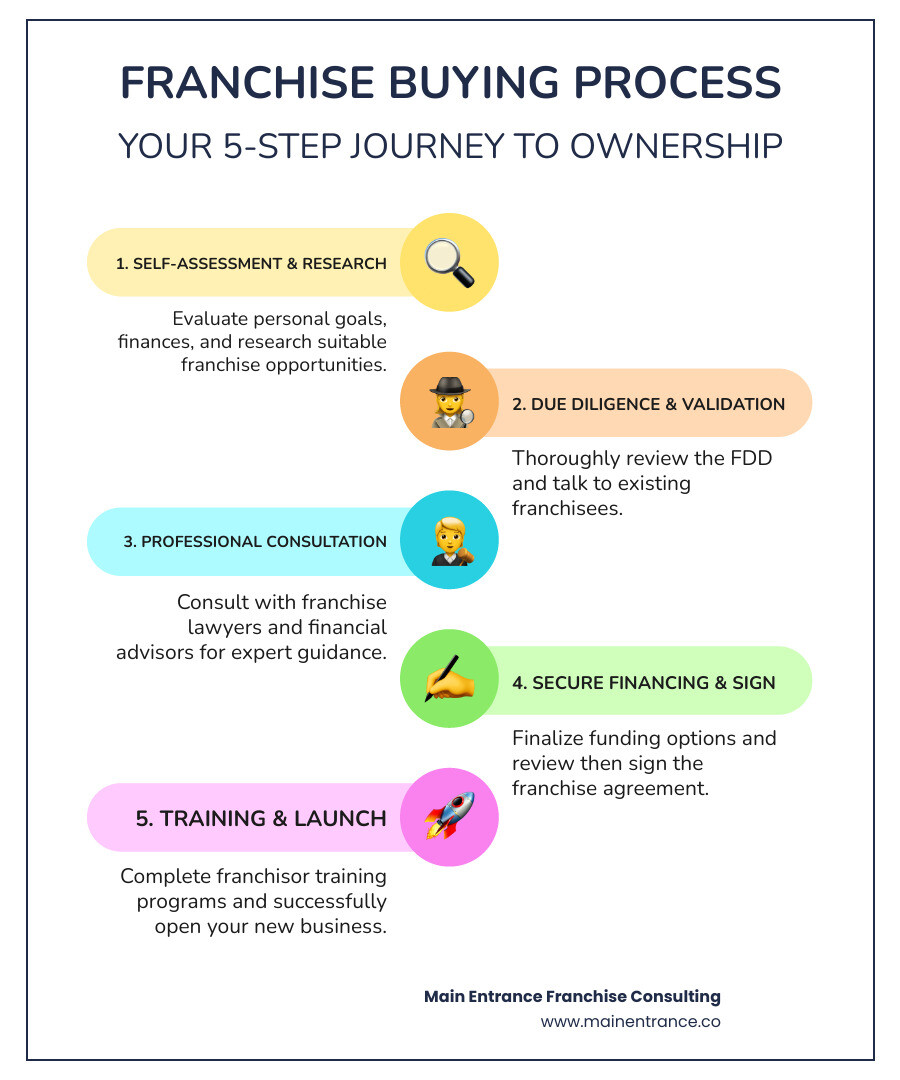
Here’s the franchise buying process in simple terms:
- Self-Assessment – Evaluate your finances, skills, and goals
- Research – Find franchises that match your interests and budget
- Due Diligence – Review the Franchise Disclosure Document (FDD)
- Validation – Talk to current and former franchisees
- Professional Review – Get legal and financial advice
- Financing – Secure funding for your investment
- Final Decision – Sign the franchise agreement
- Training & Launch – Complete franchisor training and open your business
When you buy a franchise, you purchase the right to operate using the franchisor’s system, brand, and support. In return, you follow their playbook and pay fees. This relationship creates a partnership where both parties have vested interests in your success.
Why people choose franchises: instant brand recognition, a proven model, robust training, and ongoing support. Lenders also often view franchises as less risky than independent startups, which can make securing financing more straightforward.
Trade-offs include: ongoing royalties and advertising fees, strict operating standards, and less creative control. These constraints, however, often protect franchisees from costly mistakes and help maintain brand consistency across all locations.
I’m Max Emma, a Certified Franchise Executive who has guided hundreds through the franchise buying process with experience in both franchisor and franchisee roles, helping entrepreneurs find their ideal franchise match.
The Pros and Cons of Buying a Franchise
Franchising is like using GPS: faster and clearer than going it alone, but with rules to follow. Understanding these trade-offs helps you make an informed decision about whether franchising aligns with your entrepreneurial goals.
| Feature | Buying a Franchise | Starting an Independent Business |
|---|---|---|
| Brand Power | Instant recognition, proven concept, protected trademarks | Build brand from zero, unproven concept |
| Support | Training, playbooks, ongoing help, supply chain | You build everything yourself |
| Financing | Often easier to fund; lower perceived risk | Higher perceived risk with lenders |
| Training | Structured programs and manuals | Self-taught or hire experts |
| Freedom | Limited autonomy; must follow system | Full creative control |
| Ongoing Fees | Upfront fee, royalties (often 4-9% of gross), ad fund | No royalties, but all costs are yours |
| Rules | Strict standards, approved suppliers/locations | Set your own rules |
| Obligations | Long-term contract; restrictions on future options | More flexibility to pivot or exit |
| Risk | Lower than a startup, but no guarantees | Higher inherent risk |
The right path depends on your personality, finances, and desire for structure versus freedom. Many successful franchise owners appreciate the balance between entrepreneurship and support that franchising provides.
Step 1: The Foundation – Self-Assessment and Research

Start with clarity about yourself, your market, and your money. Skipping this step is the fastest way to pick the wrong brand or underfund your startup. This foundational phase typically takes 4-8 weeks and sets the stage for everything that follows.
Are You Cut Out for Franchising?
- Do you want to own and lead a team, even when things get tough?
- Are you comfortable with risk and investing significant capital?
- Can you follow a proven system with limited freedom to improvise?
- Do you have genuine family buy-in for the time and financial commitment?
- Are you prepared for the learning curve that comes with any new business?
- Can you handle the stress of being responsible for employees and customer satisfaction?
As Joel Libava notes, “Most people aren’t right for franchise ownership because they aren’t risk-takers or dislike following rules.” Consider also whether you have the stamina for long hours during the startup phase and the patience to wait for profitability, which often takes 12-24 months. If you want to explore the mindset further, read The 4 Freedoms That Motivate Successful Franchise Owners.
Finding Your Perfect Franchise Match
- Research industries you’d enjoy (fitness, food, home or business services).
- Verify local demand: demographics, spending habits, seasonality.
- Map the competition: too little can signal no demand; too much can squeeze margins.
- Use franchise directories and attend trade shows to compare concepts.
- Consider emerging trends and recession-resistant industries.
- Evaluate whether you prefer B2B or B2C business models.
- Think about scalability – do you want to own multiple units eventually?
- Franchise associations add credibility and education; see the Canadian Franchise Association.
The best franchise for you isn’t necessarily the most popular or profitable one – it’s the one that aligns with your skills, interests, lifestyle goals, and local market conditions.
Financial Planning for the Franchise Buying Process
- Confirm liquid capital and net worth meet brand and lender minimums.
- The total initial investment goes beyond the franchise fee: build-out, equipment, initial inventory, permits, insurance, and grand-opening marketing. These are detailed in FDD Item 7.
- Budget working capital (often 3-6 months of expenses).
- Plan to cover personal living costs for at least the first year as the business ramps.
- Consider unexpected costs like additional marketing, extra staff during busy periods, or equipment repairs.
- Factor in professional fees for lawyers, accountants, and consultants.
- Understand the difference between liquid capital requirements and total net worth requirements.
- Research whether the franchise qualifies for special lending programs or if the franchisor offers financing assistance.
A realistic financial assessment now prevents cash flow crises later. Many franchise failures stem from undercapitalization rather than poor operations, making this step absolutely critical to your long-term success.
Step 2: The Core of the Franchise Buying Process – Due Diligence and Validation

This is your investigative phase. Move past marketing and verify the reality with documents, professionals, and owners in the system.
Decoding the Franchise Disclosure Document (FDD)
The FDD is designed for transparency and must be provided at least 14 days before you sign or pay. In Canada, laws like the Arthur Wishart Act offer strong rescission rights if disclosure is late, incomplete, or missing.
Key items to review:
- Item 3 (Litigation) and Item 4 (Bankruptcy): patterns of lawsuits or financial distress are red flags.
- Items 5–7 (Fees and Costs): full cost picture, not just the franchise fee.
- Item 19 (Financial Performance, if provided): understand what’s included and whether it’s typical for your market.
- Item 20 (Franchisee List): your contact roadmap for validation.
Watch for high turnover, frequent disputes, or pressure to rush.
Assembling Your Professional Team
- Franchise lawyer: reviews the FDD and agreement, clarifies controls, renewal/termination/transfer, and any negotiable areas.
- Accountant: analyzes franchisor financials, builds projections, and advises on structure and taxes.
- Consultant: Main Entrance acts as your project manager through the franchise buying process, narrowing options and coordinating steps at no upfront cost. Learn more: What is a Franchise Consultant?.
Getting the Real Story: Talking to Franchisees
Speak with several current and former owners, not just those the franchisor suggests. Ask:
- Why they chose the brand and whether they’d do it again.
- Ramp-up time, break-even, and any unexpected costs.
- Day-to-day workload and staffing realities.
- Quality and speed of franchisor support.
- Market competition and profitability context.
Candid answers reveal system strengths, gaps, and what your life will actually look like.
Step 3: The Final Stretch – Sealing the Deal and Launching Your Business
You’ve validated the opportunity. Now secure funding, finalize the legal terms, and prepare to open.
Securing Your Franchise Financing
- Bank loans and, in the U.S., SBA-backed loans are common; SBA guarantees a portion to reduce lender risk.
- Consider franchisor-arranged lending or ROBS (using retirement funds with specialist guidance).
- Expect an equity injection of ~20–30%.
- Present a solid franchise business plan with projections, market analysis, and your role. Lenders will review your credit, liquidity, and the brand’s track record.
Navigating the Legal Side of the Franchise Buying Process
Your attorney will focus on:
- Territory rights (exclusive or not) and site approval.
- Fees (initial, royalties, ad fund) and how they’re calculated.
- Controls/restrictions to protect brand standards.
- Renewal, termination, and transfer terms, including right of first refusal.
- Your exit strategy from day one.
Preparing for Opening Day
- Complete franchisor training on operations, finance, and marketing.
- Nail site selection and build-out to brand specs.
- Hire and train staff using franchisor materials.
- Execute a grand opening plan (often after a soft open) with system-tested marketing. Need support? See more info about our franchise buying services.
Frequently Asked Questions about Buying a Franchise
What are the biggest risks when buying a franchise?
You can still lose money. Sales may lag, costs can overrun, or markets can shift. You’ll have limited creative freedom and rely on the franchisor’s brand, support, and strategy. Disputes can arise over fees or standards. The best defense is rigorous due diligence: FDD review, professional advice, and frank validation calls.
How long does the franchise buying process typically take?
Plan on 3–12 months from serious inquiry to signing. Timing depends on your pace through due diligence, financing (SBA adds steps), site selection/approval, training schedules, and any franchisor-specific milestones.
Can I negotiate the terms of a franchise agreement?
Core economics (initial fees, royalties, ad fund) are usually non-negotiable for system consistency. Limited terms may flex (e.g., territory nuances, timelines, training dates). Your franchise attorney will identify what’s realistic and ensure any changes are documented properly.
Conclusion: Your Path to Entrepreneurship Starts Here
The franchise buying process becomes simple when you follow the steps: know yourself, research smart, validate thoroughly, lean on experts, and launch with a plan. You don’t need an MBA—just discipline and the right guidance.
Franchising offers a proven model, training, and support, but success still hinges on fit and diligence. At Main Entrance Franchise Consulting, our client-first approach and expert guidance come with no upfront costs.
Ready to explore franchise ownership with confidence? Start your franchise buying journey with an expert consultation today.